
Germany Opportunity Card 2026: Move to Germany to Find a Job — No Offer Needed
Germany will let a qualified professional move there for up to a year to look for work — before any employer has said yes. That is the whole idea behind the Opportunity Card, and in 2026 it is one of the few realistic routes into Europe’s largest economy that does not start with a job offer. This guide covers exactly who qualifies, how the points actually add up, the money you need to show, and the quiet traps that sink most applications.
What is the Germany Opportunity Card 2026? The Opportunity Card (Chancenkarte) is a residence permit that lets skilled non-EU professionals live in Germany for up to 12 months to search for a qualified job — with no job offer required upfront. You qualify either through a recognized degree or trade qualification, or by scoring at least six points on a flexible points system, while meeting basic language and financial rules.
That single feature — no offer needed — is why the card matters for anyone stuck in the classic trap of “employers want you in-country, but you can’t get in-country without an employer.” Below is the honest, numbers-first breakdown for 2026.
Two ways to qualify — you only need one
There are two separate doors into the Opportunity Card, and you only have to walk through one of them.
Route 1 — Recognized skilled worker (no points test). If your foreign university degree or vocational qualification is fully recognized in Germany — or you earned it in Germany — you skip the points system entirely. You still have to meet the language and financial rules, but you don’t count a single point. This is the cleaner path, and if it’s open to you, take it.
Route 2 — The points system. If your qualification isn’t fully recognized (yet), you can still qualify by scoring a minimum of 6 points on the Chancenkarte grid. Points come from a mix of your qualification, work experience, language ability, age, and ties to Germany. This is the route most international applicants end up using.
The legal basis for all of this is Section 20a of Germany’s Residence Act (Aufenthaltsgesetz), and the card has been running since June 1, 2024. So while it still feels new, it is now an established, tested pathway — not an experiment.
The 2026 money rules (get these exact)
Money is where applications fall apart, so pin these numbers down before you do anything else. For 2026, you must prove financial self-sufficiency of at least €1,091 per month, which works out to roughly €13,092 for the year. Because figures like this get adjusted, confirm the current amount on an official source (Make it in Germany or the German mission serving you) before you fund an account.
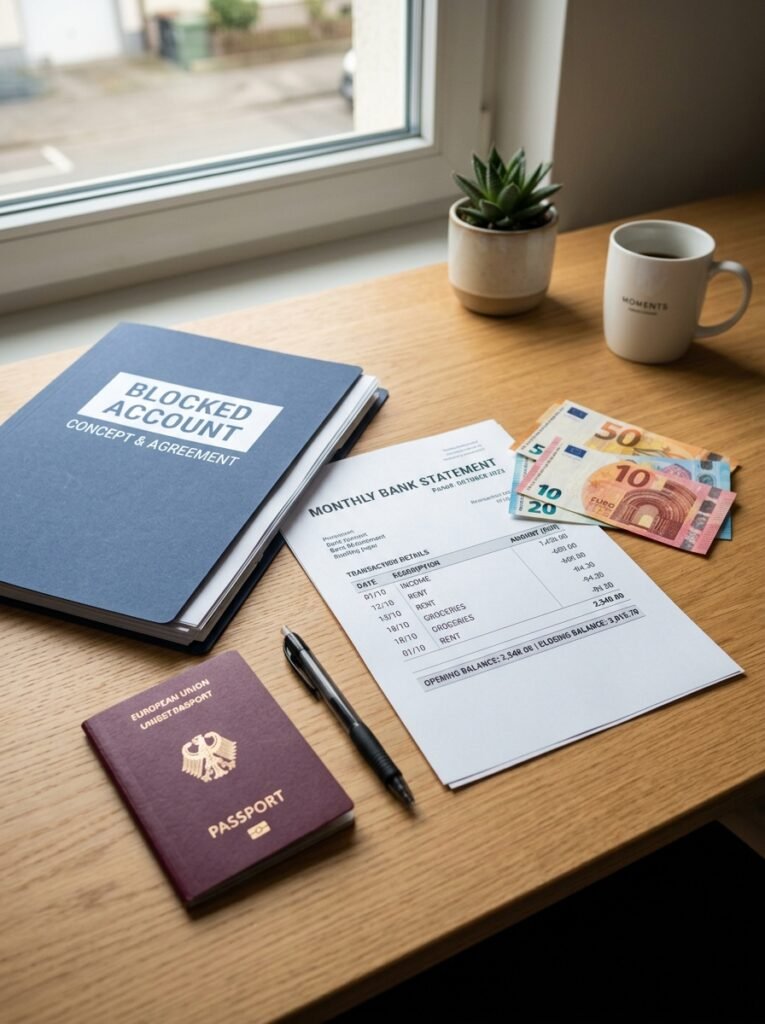
You can prove those funds in a few ways, but the most widely accepted is a blocked account (Sperrkonto) holding the annual amount. A formal declaration of commitment from a sponsor in Germany, or a qualifying part-time job contract, can also work depending on what your consulate accepts.
Once you’re in Germany on the card, you’re allowed to support yourself with limited work (more on that next), and Germany’s statutory minimum wage rose to €13.90 per hour as of January 1, 2026 — which is what makes a 20-hour-a-week job actually cover living costs.
What you can and can’t do on the card
The Opportunity Card is a job-search permit, not a full work permit, so the work rights are deliberately limited:
- You may work part-time, up to 20 hours per week, in any sector.
- You may take trial employment (Probebeschäftigung) of up to two weeks per employer, with no cap on how many trials you do. This is the card’s secret weapon — use it to let employers “test drive” you.
- You cannot take a full-time permanent role until you convert the card into a proper work permit.
The card itself is issued for a maximum of 12 months. If you land a qualifying offer but can’t yet convert to a standard permit, a follow-up Opportunity Card (Anschluss-/Folge-Chancenkarte) of up to two more years may be granted — but this is a fallback, not a guaranteed extension.
How the points actually add up
The single most common mistake is treating “6 points” as easy. It isn’t automatic. Points are awarded across several buckets, and English alone won’t get you there. Broadly, points come from:
- Qualification recognition — a partially recognized qualification is worth the most weight here.
- Work experience — more recent, relevant years score higher.
- Language ability — this is the big one. German at intermediate levels (B1/B2) scores real points; English B2 satisfies the baseline but earns zero points. If you’re relying on English only, you’ll likely fall short of six.
- Age — younger applicants score more.
- Ties to Germany — previous legal stay, study, or work in Germany.
- Spouse/partner bonus — a joint application where a partner also qualifies can add a point.
A quick worked example. Imagine an IT professional, age 33, with a foreign degree that is partially recognized, five years of experience, and German at B1. The partial recognition plus the strong experience plus the German language points can realistically clear six. Swap that B1 German for “English only,” and the same person often lands below the threshold. That one variable — real German — is usually the difference between qualifying and not.
Use the official Chancenkarte self-check on the Make it in Germany portal to estimate your score for free before you spend a euro. Do not pay an agent to “calculate your points” when the government tool does it at no cost.
The ANABIN trap that sinks applications
Here’s the pitfall the glossy guides skip. For the recognition route (and for scoring recognition points), your degree has to check out in the ANABIN database maintained by Germany’s KMK. Your university and your specific qualification both need the right rating — a degree that isn’t listed, or an institution without the correct status, will not pass. People book flights and fund blocked accounts before ever checking this, then discover their qualification doesn’t clear. Check ANABIN — or get a formal assessment — before you commit money to the process. This one step saves the most heartbreak.

After you get the card: converting to a real work visa
The Opportunity Card is a bridge, not a destination. Once you secure qualified employment, you convert it into a longer-term status — typically a standard work permit, or the EU Blue Card if your salary clears the threshold. For 2026, Germany’s EU Blue Card salary floor is €50,700 gross per year for standard occupations, and a reduced €45,934.20 for shortage occupations, recent graduates, and qualifying IT specialists. The Blue Card is the prize because it puts you on an accelerated path to permanent residence.
On arrival, remember the two-week rule: register your address (Anmeldung) at the local registration office within two weeks, then start job-hunting immediately. When an offer lands, book your appointment at the foreigners’ authority (Ausländerbehörde) to convert your status before you start full-time work.
Who this does NOT work well for
Being honest here matters more than hype, because a wasted application costs real money and months of your life.
- English-only candidates with no German. You clear the baseline but score zero language points, so the six-point math rarely works unless your qualification and experience are exceptional.
- People whose degree isn’t in (or doesn’t pass) ANABIN. If neither recognition nor the points route is realistic, this card isn’t your route — look at employer-sponsored options instead.
- Anyone who can’t genuinely fund the stay. You need real, provable money for up to a year of living costs, and part-time work at 20 hours won’t fully replace savings.
- People expecting a guaranteed job. The card gets you in to search. It does not hand you employment. Germany reports a shortage of hundreds of thousands of skilled workers a year, but you still have to compete and interview.
Watch out for scams
Where there’s demand, there are predators. Real red flags: anyone “guaranteeing” the card or a job for a fee, agents charging money to run the free points self-check, or “consultants” asking you to send funds to personal accounts. The application fee is modest and paid to the German mission, financial proof goes into your own blocked account, and the eligibility tools are free on official portals. If someone promises certainty, walk away.
Key Takeaways
- The Germany Opportunity Card 2026 lets qualified non-EU professionals live in Germany up to 12 months to find a job — no offer needed upfront.
- Qualify via full recognition (no points) or by scoring 6+ points on the Chancenkarte system.
- German language points are usually decisive — English B2 meets the baseline but scores zero.
- Show ~€1,091/month (≈€13,092/year), most reliably via a blocked account; verify the current figure officially.
- You may work 20 hours/week and do 2-week trials per employer while searching.
- Check ANABIN first — unrecognized qualifications are the #1 reason applications collapse.
- Convert to a work permit or EU Blue Card (2026 floor €50,700, or €45,934.20 for shortage/graduate/IT) once employed.
Table of Contents
FAQ
Q1. Can I get the Germany Opportunity Card 2026 without a job offer?
Yes. That’s the entire point of the card. It’s a job-search residence permit that lets qualified non-EU professionals enter Germany for up to 12 months to look for work, with no employer offer required before you apply.
Q2. How many points do I need for the Chancenkarte in 2026?
You need a minimum of six points if you’re using the points route. Points come from your qualification, work experience, language ability, age, and ties to Germany. If your qualification is fully recognized in Germany, you skip the points test entirely.
Q3. How much money do I need to show for the Opportunity Card?
For 2026 you must prove roughly €1,091 per month, about €13,092 for the year, most commonly through a blocked account (Sperrkonto). Because these figures are adjusted periodically, confirm the current amount on an official German government source before funding anything.