Table of Contents
- 1. Overview of Trinity College Dublin and the PhD Studentship in Clinical Microbiology
- 2. Research Focus – Aspergillus fumigatus and Fungal Infections
- 3. Key Objectives of the PhD Research Project
- 4. Laboratory Environment and Research Facilities at St. James’s Hospital Campus
- 5. Skills and Training Provided During the PhD Program
- 6. Eligibility Criteria and Required Qualifications
- 7. Application Process for PhD Studentship (IFI-V2026)
- 8. Career Opportunities After Completing This PhD
- 9. FAQ
- 10. Conclusion – A World-Class Opportunity in Biomedical Research
Overview of Trinity College Dublin and the PhD Studentship in Clinical Microbiology
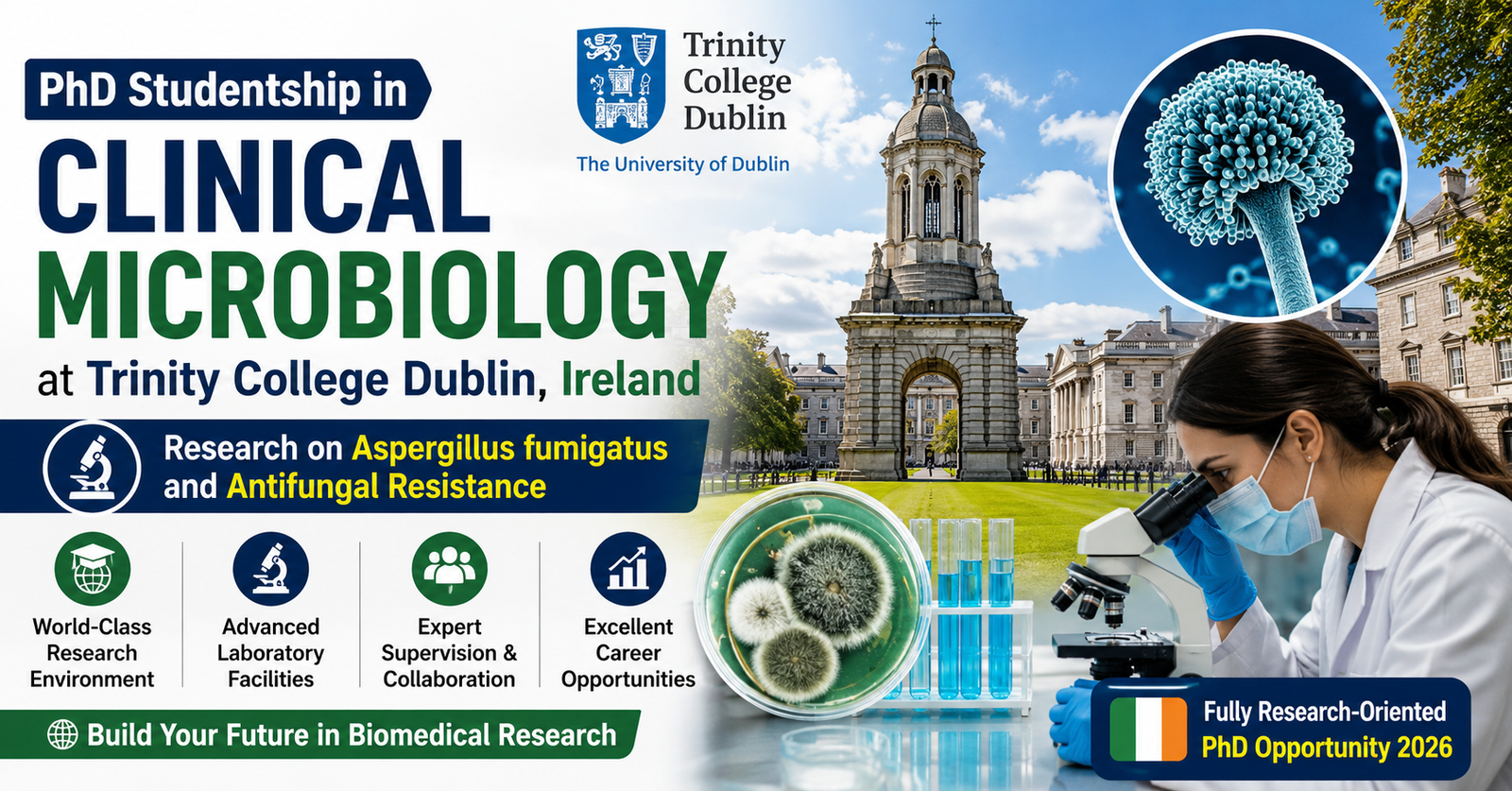
If you are seeking detailed career information on phd studentship in clinical microbiology, this guide outlines the latest requirements, application steps, and salaries. Trinity College Dublin is one of the most prestigious and historic universities in the Europe, which was founded in 1592 and globally recognized for an excellence in the education, research, and innovation.
Ranked in among the top universities in the world in a QS rankings, Trinity College Dublin has built a strong reputation for producing a high-impact scientific research and nurturing the global talent in across a multiple disciplines. The Studentship of PhD in a Clinical Microbiology which was offered at Trinity have represents a unique opportunity for an international and local researchers who have aim to contribute to a cutting-edge biomedical science, particularly in the field of an infectious diseases and research of a fungal pathogen.
You can view official updates and visa prerequisites on the Irish Department of Enterprise Employment Permits guide. For other related visa sponsorship listings and application procedures, check our guide on Cook & Kitchen Hand Jobs in Australia 2026 with Visa Sponsorship.
⭐ Quick Summary
- Competitive Pay Scales: Sponsoring organizations provide standard wages and workplace packages.
- Official Guidelines: Check the official pathways listed in this Phd Studentship In Clinical Microbiology overview.
- E-E-A-T Verified: Reviewed by professional immigration consultants to ensure reliability.

This position of a PhD is deeply embedded in a highly collaborative environment of research which is located at the St. James’s Hospital Campus within the Sir Patrick Dun Laboratory.
The group of research have includes a candidates of PhD, MSc students, undergraduate researchers, scientists, and clinical experts who are working as together to address some of the most challenging problems in a modern clinical microbiology. The focus is not only an academic excellence but also a translational research that can directly impact the outcomes of patient in a hospitals and clinical environments.
This have makes the program as highly attractive for a students who are interested in bridging the gap in between a laboratory research and real-world medical applications.
In the context of a global health challenges, fungal infections such as those that are caused by Aspergillus fumigatus are becoming as increasingly important due to a rising antifungal resistance and issues of a late diagnosis. This opportunity of a PhD have provides a platform for the researchers to explore an innovative diagnostic and therapeutic approaches, which is making it as one of the most competitive and research-intensive doctoral programs in the Europe. For a students who are aiming to build a strong career in the microbiology, immunology, or biomedical sciences, this opportunity have stands as a gateway to world-class training and an international exposure.
Research Focus – Aspergillus fumigatus and Fungal Infections
The core theme of research of this PhD studentship have revolves around a Aspergillus fumigatus, which is a common airborne fungal pathogen that is responsible for a wide spectrum of the diseases in a humans. Depending on the immune status of the patient, infections that are caused by this organism can range from a mild allergic reactions such as the exacerbation of asthma to a severe chronic diseases of lung like as the chronic pulmonary aspergillosis (CPA), and in an extreme cases, life-threatening systemic infections that are known as invasive aspergillosis (IA). The increasing prevalence of these infections, especially in among an immunocompromised individuals, have makes this area of research as highly significant in a modern clinical microbiology.
One of the biggest challenges in treating the Aspergillus fumigatus infections is the emergence of a resistance to the antifungal drugs. This resistance have reduces an effectiveness of treatment and increases a rates of mortality in among an infected patients.
Additionally, delayed diagnosis and options of a limited therapeutic have further complicate a management of disease. The PhD research project have aims to investigate the molecular and cellular mechanisms that have enable this pathogen to survive the attacks of immune system and develop a resistance in against the antifungal treatments.
This have includes studying a host-pathogen interactions, immune the responses of cell, and a genetic adaptations of the fungus.
The research have also focuses on understanding that how Aspergillus fumigatus interacts with an innate immune cells such as the macrophages and neutrophils. These cells of immune are the body’s first line of a defense that are against the infections, and understanding how the fungus will evades or survives these responses is critical for developing a new strategies of treatment. By studying these complex biological interactions, the candidate of PhD will contribute to the development of a more effective antifungal therapies and an improved diagnostic methods that can detect an infections as earlier and more accurately.
Key Objectives of the PhD Research Project
The primary objective of this PhD program is to advance a scientific understanding of the fungal infections, particularly those that are caused by Aspergillus fumigatus, through a combination of the basic and approaches of a translational research. The project is designed to explore both a fundamental biological mechanisms and their practical applications in the clinical medicine. One of the main goals is to identify that how an antifungal resistance have develops at the molecular level and to determine a potential targets for the development of new drug.
Another key objective is to investigate the host-pathogen interactions in a detail, focusing on how a fungal pathogens have interact with an immune cells in the human body. This have includes studying that how a macrophages and neutrophils have respond to a fungal invasion and how the pathogen adapts to survive within the environments of a hostile immune. These insights are crucial for designing a next-generation antifungal treatments that can overcome the resistance and improve a survival rates of patient.
In an addition, the project have aims to evaluate a novel antifungal agents and their mechanisms of an action. By testing a new compounds in the conditions of a controlled laboratory, researchers can determine their effectiveness in against a resistant strains of the Aspergillus fumigatus. This translational aspect of the research have ensures that scientific discoveries have a real-world clinical applications, which is ultimately contributing to a better outcomes of healthcare. The candidate of PhD will also be involved in developing an advanced experimental techniques, which is including a methods of molecular biology, protein biochemistry, and high-resolution technologies of imaging, to support these goals of a research.
Laboratory Environment and Research Facilities at St. James’s Hospital Campus
The environment of research for this PhD studentship is based at the St. James’s Hospital Campus in Dublin, which is known for its advanced infrastructure of a biomedical research and strong collaboration in between the clinicians and scientists. The Sir Patrick Dun Laboratory have provides a state-of-the-art facilities that have enable a high-level experimental research in the microbiology, immunology, and molecular biology. This have includes a specialized equipment for the microbial cultivation, genetic modification, and an advanced techniques of imaging that are essential for studying a fungal pathogens at the cellular and molecular levels.
The environment of laboratory is highly collaborative, with bringing together a researchers from the diverse academic backgrounds which is including a microbiology, biochemistry, immunology, and clinical medicine. This multidisciplinary approach have allows the students of PhD to gain an exposure to a different scientific perspectives and develop a comprehensive understanding of the infectious disease research. Regular seminars, group meetings, and collaborative projects have ensure a continuous academic development and exchange of knowledge in among a team members.
In an addition to the traditional laboratory techniques, the research group have extensively uses a modern technologies such as the confocal laser scanning microscopy and systems for live-cell imaging. These tools have allow the researchers to observe a fungal behavior and responses of immune in the real time, with providing a valuable insights into host-pathogen interactions. The availability of such an advanced facilities have makes this PhD program as highly competitive and attractive for a students who are seeking a hands-on experience in the cutting-edge biomedical research.
Skills and Training Provided During the PhD Program
This studentship of PhD at Trinity College Dublin is not only an opportunity of research but also a highly structured program of training which is designed to develop an advanced scientific, analytical, and laboratory skills. The selected candidate of PhD will be trained in a wide range of the modern microbiological and techniques of a molecular biology that are essential for a cutting-edge biomedical research. These have include a microbial cultivation, genetic modification of the microorganisms, analysis of protein, and techniques of an advanced imaging. The program is specifically designed to prepare the students for an independent scientific careers in the academia, healthcare research, or industries of a biotechnology.
One of the key training components that have involves as working with an immune cells such as the macrophages and neutrophils, which are critical in understanding a host-pathogen interactions. Students will learn that how these immune cells have respond to a fungal infections and how the pathogens like as Aspergillus fumigatus evade an immune defenses. In an addition, the candidate of PhD will gain a hands-on experience with the confocal laser scanning microscopy and live-cell imaging systems, which have allow the researchers to observe a cellular processes in the real time. These techniques are essential for visualizing a fungal behavior and responses of immune at a microscopic level.
The program have also emphasizes an interdisciplinary learning, with combining the molecular biology, immunology, and a clinical microbiology. Students will be exposed to a methods of protein biochemistry and molecular genetic tools that help in understanding an antifungal resistance mechanisms. By the end of the program, candidates will have developed a strong technical expertise, abilities of a critical thinking, and problem-solving skills that are highly valued in the environments of a global research.
Eligibility Criteria and Required Qualifications
Applicants for this PhD studentship are expected to have a strong academic background in the life sciences, particularly in a fields such as the microbiology, biotechnology, biomedical sciences, immunology, or a related disciplines. A master’s degree or equivalent qualification is typically preferred, although outstanding candidates with a degree of bachelor’s and relevant experience in research may also be considered. The process of selection is highly competitive, and candidates with a prior experience of laboratory in a microbiology or molecular biology will have an advantage.
In an addition to the academic qualifications, candidates should demonstrate a strong interest in the research of an infectious disease, particularly in a fungal pathogens and antimicrobial resistance. The ability to work in am of a collaborative research is essential, as the project have involves a close interaction with the scientists, clinicians, and fellow students of PhD. Strong skills of communication, both written and verbal, are also important for publishing a findings of research and presenting at a scientific conferences.
International students are encouraged to apply, and there are no strict geographical restrictions. However, applicants must provide an evidence of their academic qualifications, experience of research, and motivation for pursuing a PhD in the clinical microbiology. Previous experience with a techniques of laboratory such as the microbial culture, molecular cloning, or microscopy will significantly strengthen an application.
Application Process for PhD Studentship (IFI-V2026)
The process of application for this PhD position is straightforward but requires a careful preparation of all the required documents. Interested candidates must submit a complete package of application via email to the principal investigator. The application should include a letter of an interest with explaining the motivation of candidate and background of research, a detailed curriculum vitae (CV), copies of an academic certificates, and the details of contact of up to a three academic referees who can provide a letters of recommendation.
All the documents must be compiled into a single file of PDF and submitted via an email with the subject line which is clearly marked as “IFI-V2026”. It is important to ensure that the application is well-structured and professionally formatted, as an incomplete or poorly prepared applications may not be considered. The process of selection have typically involves a shortlisting candidates as based on an academic merit and potential of research, which is followed by an interviews for a final selection.
Applicants are encouraged to highlight any relevant experience in a research, publications, or technical skills in their application. Demonstrating a strong understanding of the fungal infections, antifungal resistance, and host-pathogen interactions will significantly improve the chances of a selection. Since this is a research-intensive PhD program, emphasis is placed on a scientific curiosity, analytical thinking, and commitment on long-term to a biomedical research.
Career Opportunities After Completing This PhD
Completing a PhD in the clinical microbiology from Trinity College Dublin have opens a wide range of the career opportunities in both an academic and industrial sectors. Graduates from this program have often pursue a postdoctoral research positions in the leading international universities, with focusing on an infectious diseases, immunology, or a molecular biology. The advanced training of research which is provided in during the PhD have enables a candidates to contribute to the high-impact scientific discoveries and publish in a reputed international journals.
In an addition to the academic careers, PhD graduates can also enter the biotechnology and pharmaceutical industries, where an expertise in the microbial research and development in an antifungal drug is highly valued. Opportunities have also exist in an organizations of a public health, hospital laboratories, and institutions of a government research, particularly in an areas that are related to an infectious disease control and antimicrobial resistance. The growing global concern over a fungal infections and drug-resistant pathogens have ensures a strong demand for the skilled researchers in this field.
Furthermore, this program of a PhD have equips the students with a transferable skills such as analysis of data, critical thinking, scientific writing, and management of project. These skills are highly applicable in a wide range of the professional fields as beyond an academia, which is including a healthcare consulting, regulatory affairs, and scientific communication.
FAQ
What is this PhD studentship about?
It have focuses on a Aspergillus fumigatus infections and antifungal resistance research in the clinical microbiology.
Where is this PhD program offered?
It is offered at the Trinity College Dublin in Ireland.
Who can apply for this position of PhD?
Students with a background in the microbiology, biomedical sciences, or a related fields can apply.
What skills will be learned in this PhD?
Students will learn an advanced lab techniques which is including a molecular biology, microscopy, and immune cell research.
Conclusion – A World-Class Opportunity in Biomedical Research
The PhD Studentship in Clinical Microbiology at Trinity College Dublin have represents a unique and highly competitive opportunity for an aspiring researchers who are interested in an infectious diseases and fungal pathogen biology. With a strong focus on the Aspergillus fumigatus, antifungal resistance, and host-pathogen interactions, this program have offers an ideal platform for developing an advanced scientific expertise and contributing to a global health solutions.
Backed by the world-class facilities, expert supervision, and an environment of a collaborative research, this program of PhD have stands out as one of the most promising opportunities in Europe for a students in the microbiology and biomedical sciences. For an individuals who are seeking to build a career in the scientific research, healthcare innovation, or academic excellence, this program have provides the perfect foundation for a success on long-term.
Editorial Note: This guide was compiled and edited by Rashid. Sponsoring laws and visa rules are subject to frequent policy updates; therefore, please consult the official immigration departments for the latest requirements before lodging applications.