Table of Contents
- 1. Introduction to Electrical Signature Analysis Specialist Job at Samotics
- 2. About Samotics B.V. and Its AI-Driven Industrial Technology
- 3. Job Overview – Electrical Signature Analysis Specialist in Netherlands
- 4. Key Responsibilities of ESA Specialist at Samotics
- 5. Required Qualifications and Skills for ESA specialist Job
- 6. Technical Knowledge Areas for Electrical Engineering Candidates
- 7. Career Growth and Opportunities in Industrial AI Engineering
- 8. Salary, Benefits, and Visa Sponsorship in Netherlands
- 9. Working Environment and Company Culture at Samotics
- 10. How to Apply for Electrical Signature Analysis Specialist Job
- 11. Why This Job is Important for Future Industrial Automation
- 12. FAQs
- 13. Final Thoughts on ESA Specialist Career in Europe
Introduction to Electrical Signature Analysis Specialist Job at Samotics
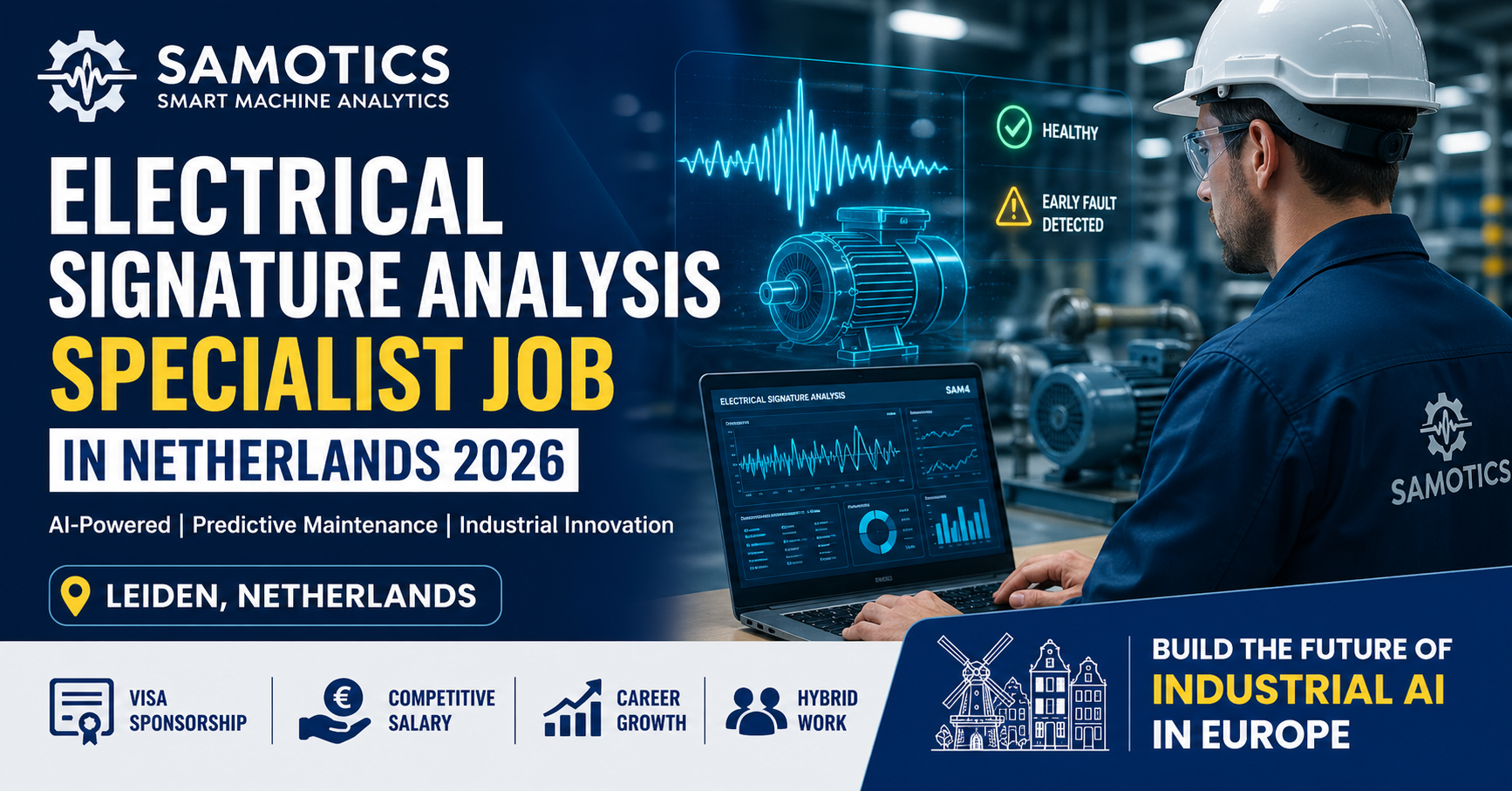
If you are seeking detailed career information on electrical signature analysis specialist job, this guide outlines the latest requirements, application steps, and salaries. The role of an Electrical Signature Analysis Specialist at Samotics in the Netherlands represents one of the most advanced and high-demand engineering careers in the modern industrial technology sector.
In 2026, industries across Europe are rapidly shifting toward AI-driven predictive maintenance systems, and this job sits at the core of that transformation. The specialist works on analyzing electrical signals from industrial machines to detect early signs of failure, which helps companies prevent costly downtime and energy waste.
You can view official updates and visa prerequisites on the Dutch IND Highly Skilled Migrant portal. For other related visa sponsorship listings and application procedures, check our guide on Roofing labourer jobs New Zealand – Watertight Roofing Careers 2026.
⭐ Quick Summary
- Competitive Pay Scales: Sponsoring organizations provide standard wages and workplace packages.
- Official Guidelines: Check the official pathways listed in this Electrical Signature Analysis Specialist Job overview.
- E-E-A-T Verified: Reviewed by professional immigration consultants to ensure reliability.

This position is not just a traditional engineering job; it is a combination of electrical engineering, data science, artificial intelligence, and real-world industrial problem-solving. The specialist uses Electrical Signature Analysis (ESA) techniques to monitor rotating machines such as motors, pumps, and industrial drive systems. By studying electrical patterns and signal behavior, they can identify hidden faults long before actual breakdowns occur. This makes the role extremely valuable in industries like manufacturing, oil and gas, water treatment, and energy production.
Samotics, a leading Netherlands-based technology company, focuses on reducing global energy consumption and improving industrial efficiency. Their mission is to reduce energy waste and eliminate unplanned downtime using smart monitoring systems. The ESA Specialist plays a key role in achieving this mission by working closely with data scientists, AI engineers, and customer success teams. The work is highly analytical and research-driven, requiring both theoretical knowledge and practical experience in electrical machines.
Overall, this role is ideal for professionals who want to contribute to sustainable energy solutions while working in a fast-growing European tech environment. It offers not only technical growth but also international career exposure through visa sponsorship and relocation opportunities.
About Samotics B.V. and Its AI-Driven Industrial Technology
Samotics B.V. is a fast-growing industrial technology company based in Leiden, Netherlands, specializing in AI-powered condition monitoring systems. The company has developed a unique platform known as SAM4, which uses Electrical Signature Analysis combined with machine learning algorithms to detect faults in industrial equipment. This advanced system allows companies to predict machine failures before they happen, significantly reducing maintenance costs and preventing unexpected shutdowns.
The core mission of Samotics is to make industrial operations more sustainable by reducing global energy consumption. According to their vision, improving machine efficiency and preventing unnecessary downtime can have a massive impact on environmental sustainability. This makes the company not just a tech organization but also a contributor to global energy conservation efforts.
Samotics operates in a cross-functional environment where electrical engineers, data scientists, and AI specialists collaborate closely. The ESA Specialist is a critical part of this ecosystem because they bridge the gap between raw electrical data and actionable insights. Their analysis helps improve AI models and enhances the accuracy of predictive maintenance systems.
The company culture at Samotics is highly innovative and research-oriented. Employees are encouraged to explore new methods, develop experimental models, and test real-world industrial applications. This makes it an attractive workplace for engineers who want to work on cutting-edge technology rather than routine tasks. Additionally, Samotics supports relocation, visa sponsorship, and provides a modern hybrid working environment, making it accessible for international talent.
Job Overview – Electrical Signature Analysis Specialist in Netherlands
The Electrical Signature Analysis Specialist role at Samotics is a full-time engineering position based in Leiden, Netherlands. It focuses on research and development activities related to industrial machine diagnostics. The job requires deep technical understanding of electrical machines, signal processing techniques, and failure detection methods.
In this role, the specialist works on analyzing real-world data collected from industrial machines operating in various environments. These machines often include motors, pumps, and complex drive systems used in industries such as manufacturing plants, oil refineries, and water treatment facilities. The goal is to detect anomalies in electrical signals that indicate potential faults or inefficiencies.
Another key aspect of the job is improving the company’s AI-driven monitoring system. The ESA Specialist contributes by developing new features based on signal processing techniques such as Fourier Transform and time-frequency analysis. These features are then integrated into machine learning models that enhance predictive accuracy.
The role also involves close collaboration with internal teams such as data scientists, customer success managers, and condition monitoring analysts. This ensures that technical findings are properly communicated to clients and translated into practical solutions.
Because of its technical depth and global relevance, this job is considered highly prestigious in the engineering field. It offers strong career growth opportunities, international exposure, and the chance to work on advanced industrial AI systems that are shaping the future of manufacturing and energy industries.
Key Responsibilities of ESA Specialist at Samotics
The responsibilities of an Electrical Signature Analysis Specialist at Samotics are highly technical and research-focused. One of the main tasks is analyzing electrical signals from industrial machines to detect early-stage faults. This requires strong expertise in signal processing and an understanding of how electrical systems behave under different operating conditions.
Another major responsibility is performing root cause failure analysis. When a machine shows abnormal behavior, the specialist investigates the underlying cause using ESA data. This involves studying electrical waveforms, identifying irregular patterns, and determining whether the issue is related to mechanical wear, electrical faults, or operational conditions.
The ESA Specialist also plays an important role in improving the company’s condition monitoring tools. By developing new analytical features, they help enhance the accuracy of AI models used in predictive maintenance systems. This includes working with mathematical techniques and data-driven algorithms to improve system performance.
Communication is another key responsibility. The specialist must clearly explain technical findings to non-technical stakeholders, including customers and internal teams. This ensures that industrial clients understand the condition of their equipment and can take preventive action when needed.
Additionally, the role involves documenting failure cases and suggesting improvements based on historical data. This helps the company continuously refine its monitoring system and improve long-term reliability.
Required Qualifications and Skills for ESA specialist Job
The Electrical Signature Analysis Specialist position at Samotics requires a strong academic and technical foundation in engineering, particularly in Electrical or Mechanical Engineering. Most candidates are expected to hold at least a Master’s degree (MSc) in a relevant field, while PhD-level applicants with research experience are also highly preferred. In addition to academic qualifications, the company values practical experience in diagnosing and analyzing electrical machines using Electrical Signature Analysis (ESA) techniques.
One of the most important requirements is a deep understanding of electrical motors and rotating machinery systems. Candidates should be familiar with how motors operate under different loads, how electrical signals behave in real-time industrial environments, and how faults develop over time. Knowledge of electrical machine modeling is considered an added advantage, especially for candidates who have worked in simulation environments or laboratory testing setups.
Another critical skill is familiarity with Variable Frequency Drives (VFDs) and control systems. Since many industrial machines operate using VFDs, understanding how these systems influence electrical signals is essential for accurate diagnosis. Along with this, candidates should also have knowledge of drive-train systems, which include components such as feeders, motors, transmissions, and end applications. A strong understanding of failure modes across these systems is necessary for performing root cause analysis effectively.
Programming skills, especially in Python, are highly desirable for this role. Python is widely used in data analysis, signal processing, and AI model integration within Samotics’ systems. Candidates should be comfortable working with data libraries and processing large datasets to extract meaningful insights from electrical signals. In addition, familiarity with Fourier Transform, time-frequency analysis, and wavelet techniques is considered a strong advantage.
Communication skills are equally important, as the ESA Specialist must explain complex technical findings to clients and non-technical teams. Experience in industrial communication environments, especially when discussing failure detection results, is highly valuable. English fluency is required, while knowledge of a second language can be an additional benefit for working in international environments.
Technical Knowledge Areas for Electrical Engineering Candidates
The ESA Specialist role requires deep technical expertise in several engineering domains. One of the most important areas is Electrical Signature Analysis itself, which involves studying electrical waveforms to identify anomalies in machine behavior. This technique is widely used in predictive maintenance systems to detect faults before they lead to machine failure.
Signal processing is another core technical requirement. Engineers must be able to analyze raw electrical signals and convert them into meaningful data using mathematical tools such as Fourier Transform and spectral analysis. These methods help identify hidden patterns in electrical currents and voltages that are not visible through traditional monitoring techniques.
A strong understanding of rotating electrical machines is also essential. This includes knowledge of motors, generators, and industrial drive systems. Engineers must understand how these machines behave under different load conditions and how faults such as bearing failure, rotor imbalance, or insulation degradation can be detected through electrical signals.
In addition, familiarity with condition monitoring technologies is highly important. This includes not only ESA but also vibration analysis, thermal monitoring, and other predictive maintenance techniques. Combining multiple monitoring methods allows for more accurate fault detection and system reliability.
Knowledge of electrical line diagrams and grounding systems is also required. These diagrams help engineers understand how electrical systems are structured and how faults propagate through different components. A strong theoretical foundation combined with practical experience ensures accurate diagnostics and system improvement.
Career Growth and Opportunities in Industrial AI Engineering
The Electrical Signature Analysis Specialist role offers exceptional career growth opportunities in the rapidly expanding field of industrial AI and predictive maintenance. As industries across Europe and the world adopt smart manufacturing systems, professionals with expertise in ESA and condition monitoring are becoming increasingly valuable.
One of the biggest advantages of this role is exposure to cutting-edge AI technology. Samotics integrates artificial intelligence with electrical engineering to create advanced monitoring systems. This allows engineers to work at the intersection of multiple disciplines, including data science, machine learning, and industrial engineering.
Career progression in this field can lead to senior roles such as Lead ESA Engineer, AI Systems Engineer, or Industrial Data Science Specialist. With experience, professionals can also move into research and development leadership positions, where they design next-generation monitoring systems for global industries.
Another important aspect of career growth is international exposure. Since Samotics is based in the Netherlands and supports visa sponsorship through EU Blue Card programs, engineers have the opportunity to work in a highly developed European engineering ecosystem. This experience significantly enhances global career prospects.
The demand for predictive maintenance experts is expected to grow rapidly in the coming years due to increasing focus on energy efficiency and sustainability. Engineers in this field are not only building successful careers but also contributing to global environmental goals by reducing energy waste and improving industrial efficiency.
Salary, Benefits, and Visa Sponsorship in Netherlands
The Electrical Signature Analysis Specialist position at Samotics comes with a highly competitive salary package, reflecting the advanced technical expertise required for the role. In the Netherlands, engineering salaries are generally strong, and this role falls into the high-demand category of industrial AI and predictive maintenance professionals.
In addition to salary, employees receive a comprehensive benefits package that includes pension schemes, paid holidays, parental leave, and performance-based incentives. One of the most attractive features is the Stock Appreciation Rights (SAR) scheme, which allows employees to benefit financially from the company’s growth and potential future success.
For international candidates, visa sponsorship is a major advantage. Samotics supports relocation and provides assistance under the EU Blue Card or Highly Skilled Migrant programs. This makes it easier for qualified engineers from outside Europe to move and work in the Netherlands legally.
The company also offers hybrid working options, allowing employees to balance remote work with onsite collaboration. This flexibility improves work-life balance while maintaining strong team coordination. Additional perks include on-site meals, snacks, drinks, and regular company events, which create a strong and engaging workplace culture.
Living and working in the Netherlands also provides long-term career benefits. The country is known for its strong engineering sector, high quality of life, and excellent infrastructure. Cities like Leiden offer a modern, safe, and innovation-driven environment, making it an ideal location for international professionals.
Working Environment and Company Culture at Samotics
Samotics promotes a highly innovative and collaborative work environment where engineers, data scientists, and AI specialists work together to solve complex industrial problems. The company culture is based on freedom, responsibility, and continuous learning, which encourages employees to explore new ideas and contribute to technological advancements.
The workplace is designed to support creativity and research-driven development. Engineers are not limited to routine tasks; instead, they are encouraged to analyze real-world industrial problems and develop innovative solutions. This makes the job intellectually stimulating and professionally rewarding.
Team collaboration is a key part of the company’s culture. ESA Specialists work closely with data science teams to improve AI models and enhance predictive maintenance systems. Regular communication with customer success teams ensures that technical insights are effectively translated into practical solutions for industrial clients.
Samotics also places strong emphasis on sustainability and environmental impact. The company office is built using recycled materials, and the organization actively works toward reducing global energy consumption. This mission-driven approach gives employees a sense of purpose beyond just technical work.
Company events such as workshops, social gatherings, chess tournaments, and knowledge-sharing sessions help build a strong community within the organization. This balanced environment makes Samotics an attractive workplace for engineers seeking both professional growth and a positive work culture.
How to Apply for Electrical Signature Analysis Specialist Job
Applying for the ESA Specialist role at Samotics involves submitting a detailed professional application that highlights your technical expertise and relevant experience. Candidates are expected to demonstrate strong knowledge in electrical engineering, signal processing, and industrial diagnostics.
The application process typically begins with an online submission of your CV and cover letter. It is important to clearly highlight experience related to electrical motors, condition monitoring, predictive maintenance, and Python programming. Any experience in ESA, vibration analysis, or machine failure diagnostics should be emphasized.
Shortlisted candidates may go through technical interviews where they are tested on engineering concepts, problem-solving abilities, and real-world case scenarios. These interviews often focus on how candidates approach fault detection and system analysis in industrial environments.
In some cases, candidates may also be given technical assessments involving signal processing or data interpretation tasks. This helps the company evaluate practical skills and analytical thinking abilities.
Successful candidates receive an offer that includes relocation support, visa sponsorship, and onboarding assistance to help them integrate into the Netherlands work environment.
Why This Job is Important for Future Industrial Automation
The Electrical Signature Analysis Specialist role is not just a job—it represents the future of industrial automation and smart manufacturing. As industries move toward digital transformation, predictive maintenance systems are becoming essential for reducing downtime, improving efficiency, and saving energy.
ESA technology plays a critical role in this transformation by enabling real-time monitoring of electrical machines. Instead of waiting for machines to fail, industries can now predict failures in advance and take preventive action. This shift from reactive to predictive maintenance is revolutionizing industrial operations worldwide.
The integration of artificial intelligence with electrical engineering further enhances the capabilities of these systems. Machine learning models continuously improve based on data collected from industrial environments, making fault detection more accurate over time.
Professionals working in this field are contributing directly to global sustainability goals. By reducing energy waste and preventing unnecessary machine failures, they are helping industries become more efficient and environmentally friendly.
FAQs
What is Electrical Signature Analysis Specialist job?
It is an engineering role focused on detecting machine faults using electrical signal analysis and AI tools.
Where is Samotics located?
Samotics is based in Leiden, Netherlands and works on industrial AI-driven monitoring systems.
What qualifications are required for ESA Specialist job?
A Master’s or PhD in Electrical or Mechanical Engineering with experience in motor diagnostics and signal processing.
Does this job offer visa sponsorship?
Yes, Samotics provides relocation support and visa sponsorship for qualified international candidates.
Final Thoughts on ESA Specialist Career in Europe
The Electrical Signature Analysis Specialist role at Samotics in the Netherlands is one of the most advanced and future-focused engineering careers available today. It combines electrical engineering, AI, data science, and industrial innovation into a single high-impact profession.
For engineers who are passionate about solving real-world industrial problems, this role offers a unique opportunity to work on cutting-edge technology while contributing to global energy efficiency. The combination of strong salary, visa sponsorship, international exposure, and innovative work environment makes it highly attractive for skilled professionals worldwide.
As industries continue to evolve toward smart automation and AI-driven systems, the demand for ESA specialists will continue to grow. This makes it not only a stable career choice but also a highly future-proof one.
Editorial Note: This guide was compiled and edited by Rashid. Sponsoring laws and visa rules are subject to frequent policy updates; therefore, please consult the official immigration departments for the latest requirements before lodging applications.