Table of Contents
- 1. Introduction to the Opportunity in Associate Air Quality Engineer job
- 2. About Tonkin & Taylor – Leading Environmental Consultancy in Australia & New Zealand
- 3. Associate Air Quality Engineer / Scientist Job Overview
- 4. Key Responsibilities of the Role
- 5. Required Skills and Qualifications for Associate Air Quality Engineer / Scientist
- 6. Air Dispersion Modelling – AERMOD and CALPUFF Expertise
- 7. Regulatory Framework and Environmental Compliance in Australia
- 8. Business Development and Leadership Responsibilities
- 9. Benefits, Career Growth, and Why This Role is a Strong Opportunity in 2026
- 10. FAQ
- 11. Final Conclusion – A High-Impact Environmental Career Path
Introduction to the Opportunity in Associate Air Quality Engineer job
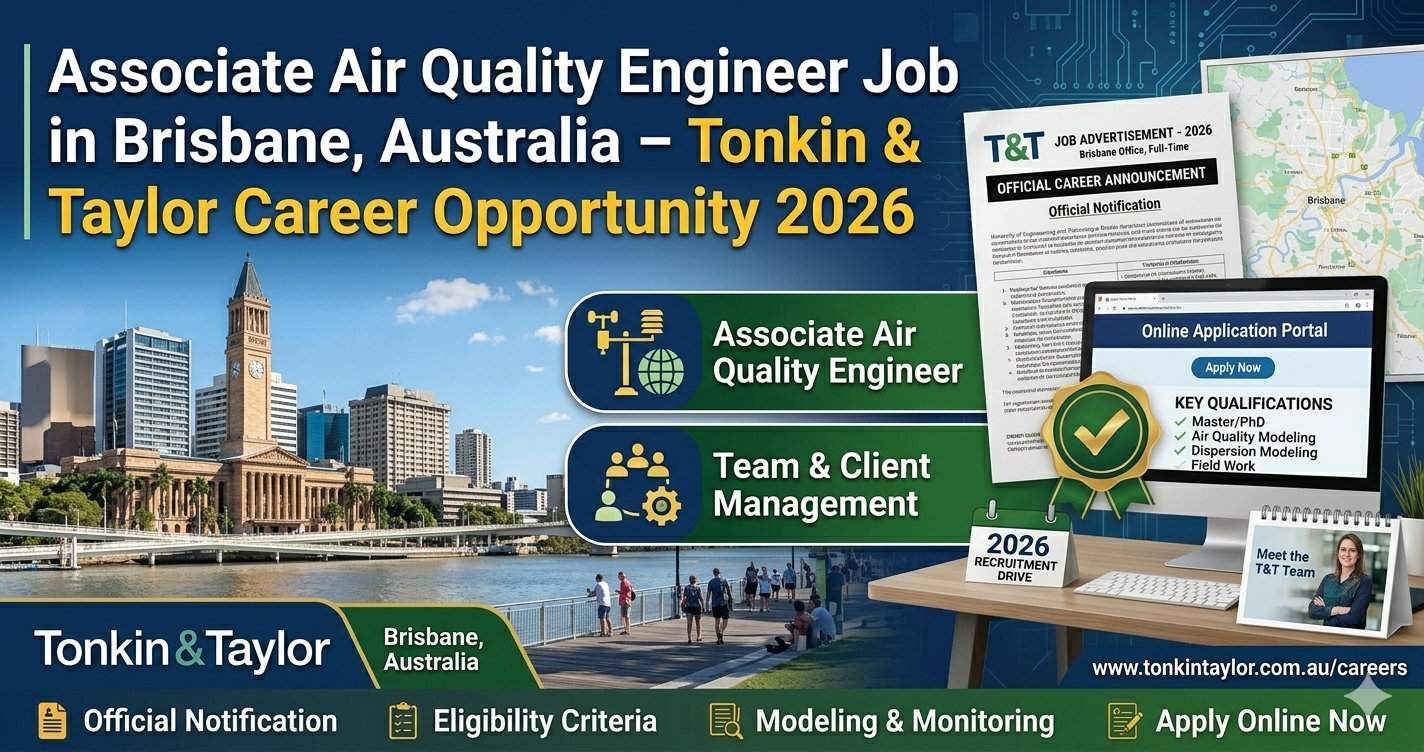
If you are seeking detailed career information on associate air quality engineer job, this guide outlines the latest requirements, application steps, and salaries. The role of an Associate Air Quality Engineer / Scientist at Tonkin & Taylor in the Brisbane, Australia have represents one of the most advanced and career-defining opportunities in the sector of environmental consultancy.
In 2026, the demand for an air quality specialists is rapidly increasing due to a stricter environmental regulations, concerns of a climate change, industrial expansion, and projects of an urban development in across the Australia. This job is not just a position of standard engineering; it is an opportunity of a leadership-level that have combines a technical expertise, environmental responsibility, and responsibilities of a business development within a highly respected firm of consultancy.
You can view official updates and visa prerequisites on the Australian Department of Home Affairs visa database. For other related visa sponsorship listings and application procedures, check our guide on Research Fellow Job Singapore 2026 – Full Job Details, Eligibility, Salary & Application Process.
⭐ Quick Summary
- Competitive Pay Scales: Sponsoring organizations provide standard wages and workplace packages.
- Official Guidelines: Check the official pathways listed in this Associate Air Quality Engineer Job overview.
- E-E-A-T Verified: Reviewed by professional immigration consultants to ensure reliability.
Tonkin & Taylor is recognized as a leading trans-Tasman engineering and environmental consultancy with an offices in across the Australia and New Zealand. The company is widely respected for its technical excellence, sustainability-driven approach, and a commitment to solving the complex environmental challenges. This position is designed for an experienced professionals who are ready to lead the projects of air quality, manage relationships with client, and contribute to a processes of large-scale on an environmental decision-making. The role have offers an exposure to a high-impact projects such as the industrial emissions assessments, approvals of infrastructure development, mining the sector environmental studies, and regulatory compliance reporting.
In today’s global environmental landscape, management of an air quality has become an area of critical focus. Governments and industries are under a pressure to reduce the pollution, control a dust emissions, and minimize the odour impacts on a communities. This has created a strong demand for the experts in air dispersion modelling, environmental impact assessments, and a regulatory compliance. The role of Associate Air Quality Engineer have directly contributes to these needs, with making it a highly valuable and future-proof career path for a professionals in an environmental science and engineering.
About Tonkin & Taylor – Leading Environmental Consultancy in Australia & New Zealand
Tonkin & Taylor is a well-established employee-owned consultancy which is known for its strong technical culture and collaborative environment of working. The company have operates in across a multiple disciplines which is including an environmental science, civil engineering, geotechnical engineering, and sustainability consulting. Within the environmental division, air quality services have play a key role in supporting the development of infrastructure, industrial approvals, and an environmental compliance in across the Australia.
The organization follows a “humble high-achievers” culture, which emphasizes teamwork, innovation, and continuous professional growth. Employees are encouraged to take ownership of projects, develop leadership capabilities, and contribute to meaningful environmental outcomes. Unlike traditional corporate environments, Tonkin & Taylor places strong emphasis on employee development, well-being, and career progression on long-term.
In the Australian market, the company have supports a wide range of an industries which is including a mining, infrastructure of transport, energy, manufacturing, and an urban development. The air quality team have works as closely with the agencies of government, regulatory bodies, and a private sector clients to ensure the compliance with an environmental standards such as NEPM (National Environment Protection Measures) and state-level EPA regulations. This have ensures that all the projects have meet a strict requirements of environmental approval while maintaining a sustainable practices of development.
For a professionals who are entering or advancing in this role, Tonkin & Taylor have offers an exposure to international best practices, advanced tools of modelling like as AERMOD and CALPUFF, and multi-disciplinary opportunities for collaboration. This have makes it an ideal environment for an engineers and scientists who want to build both a technical expertise and skills of leadership in an environmental consultancy.
Associate Air Quality Engineer / Scientist Job Overview
The role of Associate Air Quality Engineer / Scientist is a senior technical position that have combines the environmental analysis, project leadership, and responsibilities of a client engagement. This position have requires the ability to manage a complex assessments of air quality while also contributing to the growth of business and strategic direction within the organization.
The role have primarily focuses on an air dispersion modelling, environmental impact studies, odour and dust assessments, and programs of an ambient air monitoring. Professionals in this position are expected to deliver a high-quality technical reports that have support an environmental approvals under the frameworks of an Australian regulatory. In an addition, they are responsible for mentoring a junior staff and contributing to the overall development of the air quality team in across the Australia and New Zealand.
This is not a purely technical role; it also includes a responsibilities of leadership and business development. The selected candidate will play a key role in expanding the air quality services of company, building a strong relationships with client, and identifying an opportunities of new project in the environmental consultancy market. This have makes it a hybrid position with combining an expertise in engineering with a strategic business skills.
Due to the increasing environmental regulations and projects of an infrastructure development in across the Australia, this role is highly relevant in a 2026. Professionals in this field are expected to have a deep understanding of an environmental systems, processes of a regulatory compliance, and advanced techniques of modelling that help to predict and control the impacts of air pollution.
Key Responsibilities of the Role
The position of Associate Air Quality Engineer / Scientist have includes a wide range of the technical and responsibilities of leadership that require both an analytical and strategic thinking. One of the primary responsibilities is conducting the air dispersion modelling using an industry-standard tools such as the AERMOD and CALPUFF. These models are essential for predicting how the pollutants have spread in the atmosphere and assessing their impact on a surrounding communities and ecosystems.
Another important responsibility is evaluating the environmental impact of an odour, dust, and hazardous air pollutants that are generated from an industrial or projects of infrastructure. This have involves collecting the data, analyzing a sources of emission, and preparing a detailed technical assessments that have comply with a requirements of regulatory.
The role have also includes managing a programs of an ambient air quality monitoring, which have involve setting up the stations of monitoring, analyzing a meteorological data, and interpreting the trends of air pollution. These insights are used to support an environmental compliance and processes of decision-making for a clients and authorities of regulatory.
In an addition to the technical tasks, the Associate Engineer is responsible for preparing and reviewing a reports of an environmental impact assessment, regulatory submissions, and documentation of a works approval. These documents have play a critical role in obtaining the approvals of project from an agencies of government and ensuring a compliance with an environmental laws.
Furthermore, the role have includes mentoring a junior engineers and scientists, with providing a technical guidance, and supporting their professional development. Collaboration with a multi-disciplinary teams is also a key aspect, as the projects have often involve a civil engineers, geotechnical experts, planners, and environmental specialists who are working as together to deliver an integrated solutions.
Required Skills and Qualifications for Associate Air Quality Engineer / Scientist
To be considered for the position of Associate Air Quality Engineer / Scientist at Tonkin & Taylor in Brisbane, candidates must demonstrate a strong combination of a technical expertise, professional experience, and capability of leadership. This role is designed for a highly experienced environmental professionals, typically with at least a 10+ years of experience in industry in the assessment of air quality, environmental consultancy, or related fields of engineering/science. A strong academic background is essential, which is usually including a degree of Bachelor’s or Master’s in an Environmental Engineering, Chemical Engineering, Process Engineering, Environmental Science, or a closely related discipline. Postgraduate qualifications or specialized training in the modelling of an air quality or atmospheric science are considered a significant advantage and can strengthen a profile of candidate.
In an addition to the academic qualifications, the role have requires a proven practical experience in the air dispersion modelling, environmental impact assessments, and a regulatory reporting. Candidates must be comfortable as working with an advanced software of modelling such as the AERMOD and CALPUFF, which are widely used in the Australia for predicting a dispersion of pollutant in the atmosphere.
Strong analytical thinking, attention to detail, and the ability to interpret a complex environmental data are an essential skills. Communication skills are equally important because the professionals in this role must prepare a technical reports, present a findings to the clients, and engage with an authorities of regulatory in a clear and professional manner.
Leadership experience is also highly valued, as this role have involves mentoring a junior staff and contributing to the team development within a multi-disciplinary environment of consultancy.
Air Dispersion Modelling – AERMOD and CALPUFF Expertise
Air dispersion modelling is one of the most critical technical responsibilities in this role, which is forming the backbone of an air quality assessments for the industrial, infrastructure, and an environmental projects. Two of the most widely used models in this field are AERMOD and CALPUFF, both of which are essential for predicting that how the air pollutants travel, disperse, and affect the surrounding environments. AERMOD is a steady-state Gaussian plume model that is commonly used for a near-field analysis of dispersion, particularly in a regulatory applications. It is widely accepted by an environmental protection agencies in Australia and is used to assess an emissions from the industrial facilities, sites of construction, and an urban developments.
CALPUFF, on the other hand, is a more advanced model of non-steady-state puff that is used for a long-range transport and complex meteorological conditions. It is particularly useful in a situations where the terrain, coastal influences, or variable patterns of weather have affect the movement of pollutant. In a real-world applications, air quality engineers often use both a models that are depending on the complexity of the project. For an example, AERMOD may be used for a localized industrial emissions, while the CALPUFF may be used for a regional-scale environmental impact assessments.
Professionals in this role must not only operate these tools but also interpret the results as accurately and translate them into a meaningful environmental conclusions. This have includes analyzing a pollutant concentrations, assessing the compliance with a standards of regulatory, and recommending the measures of mitigation where necessary. The ability to integrate an outputs of modelling with a real-world environmental data is what distinguishes a senior-level air quality expert from a junior analyst.
Regulatory Framework and Environmental Compliance in Australia
A strong understanding of the Australian environmental regulatory framework is essential for a success in this role. Air quality professionals must ensure that all the assessments and reports have comply with a national and state-level environmental regulations. One of the key frameworks is the National Environment Protection Measures (NEPMs), which have set out a standards for the air quality in across Australia. These standards have define an acceptable limits for a pollutants such as the particulate matter (PM10 and PM2.5), nitrogen dioxide, sulfur dioxide, and carbon monoxide.
In an addition to the NEPMs, each Australian state and territory has its own Environmental Protection Authority (EPA) regulations and requirements of licensing. These agencies are responsible for approving an industrial projects, monitoring the environmental performance, and enforcing a compliance with the standards of air quality. In Queensland, for example, the Department of Environment and Science have plays a key role in reviewing an environmental impact assessments and issuing an environmental authorities for the projects of development.
Environmental consultants who are working in this role must also be familiar with a planning legislation and processes of development approval. This have includes preparing a submissions of works approval, environmental impact statements (EIS), and a technical reports that have support the project applications. Regulatory compliance is not just a legal requirement; it is also a critical factor in ensuring a sustainable development and protecting the community health. Therefore, professionals must be able to balance a technical analysis with the regulatory expectations and environmental responsibility.
Business Development and Leadership Responsibilities
Unlike a purely technical roles, the position of an Associate Air Quality Engineer / Scientist have also includes a significant responsibilities of development in business. This have means that the professionals are expected to actively contribute to the growth of the consultancy by building a strong relationships with client, identifying a new opportunities of project, and preparing a competitive proposals. In the environmental consultancy sector, business development is closely linked to a technical expertise, as the clients have often select a firms as based on the technical credibility and past project success.
At Tonkin & Taylor, associates are encouraged to take a role of leadership in expanding the air quality service line in across Australia. This have includes engaging with a industrial clients, government agencies, and x developers of leadership to understand their environmental challenges and provide a tailored solutions. Strong skills of communication and negotiation are essential in this aspect of the role, as the professionals must clearly explain a complex technical findings in a way that the non-technical stakeholders can understand.
Leadership responsibilities have also include mentoring a junior engineers and scientists, with supporting their professional development, and ensuring a technical outputs of high-quality in across the team. This have creates a collaborative environment where the sharing of knowledge and continuous improvement are prioritized. Over a time, professionals in this role can progress into a senior positions of leadership within the consultancy, with influencing a strategic direction and shaping the future of an environmental services in the region.
Benefits, Career Growth, and Why This Role is a Strong Opportunity in 2026
The role of Associate Air Quality Engineer / Scientist have offers a highly competitive package of benefits and opportunities of a strong career development. Employees at the Tonkin & Taylor benefit from an arrangements of a flexible working, professional development support, assistance of relocation (if applicable), and access to an international expertise in across the Australia and New Zealand. The company have also supports a continued education, professional memberships, and a structured programs of mentoring that have help the employees grow in their careers.
From a career perspective, this role have provides an exposure to some of the most complex and high-profile environmental projects in the Australia. These have include a developments of large infrastructure, mining operations, industrial expansions, and projects of an urban planning that have require an advanced environmental assessments. Working on such a projects have allows the professionals to build a strong technical portfolio and develop an expertise in a real-world environmental problem-solving.
In an addition, the role have offers a significant opportunities of career progression on long-term. Professionals can advance from an Associate level to a Senior Associate, Principal Consultant, or even a roles of leadership within the organization. The combination of a technical expertise, development of leadership, and involvement of business have makes this as one of the most well-rounded paths of career in the sector of an environmental engineering.
In 2026, demand for an air quality specialists is expected to grow as further due to a stricter environmental regulations, initiatives of a climate change, and increased infrastructure development in across the Australia. This have makes the role as not only financially rewarding but also as highly relevant for a career stability and professional impact on long-term.
FAQ
What is an Associate Air Quality Engineer?
A senior expert who have assesses the impact of air pollution and manages a projects of environmental air quality.
What does this job involve in Australia?
Air modelling, pollution impact studies, programs of monitoring, and a regulatory reporting.
Which tools are used in this role?
AERMOD and CALPUFF are commonly used air dispersion tools of modelling.
What qualifications are required?
Degree in an Environmental Engineering or Science with an experience of 10+ years.
Is this a high-paying job?
Yes, it is a senior-level role with a competitive salary in the Australia.
Is visa support available?
Some companies have offer a relocation and visa assistance for an international candidates.
Why is air quality engineering important?
It have helps to control a pollution and ensures an environmental safety and compliance.
Final Conclusion – A High-Impact Environmental Career Path
The position of Associate Air Quality Engineer / Scientist at Tonkin & Taylor have represents an opportunity of powerful career for an experienced environmental professionals who want to combine a technical expertise with a leadership and responsibilities of development in business. It is a role that have directly contributes to an environmental protection, sustainable development, and a regulatory compliance in the rapidly evolving industrial landscape of Australia.
With a strong demand for the expertise in air quality, advanced tools of modelling, and increasing environmental awareness, this career path have offers a growth on long-term, international exposure, and meaningful impact. For a professionals who are passionate about an environmental science and engineering, this role have stands as one of the most prestigious and future-proof opportunities in the sector of consultancy.
Editorial Note: This guide was compiled and edited by Rashid. Sponsoring laws and visa rules are subject to frequent policy updates; therefore, please consult the official immigration departments for the latest requirements before lodging applications.