Table of Contents
- 1. Introduction to Eaton Die Design & Tooling Support Specialist Jobs 2026
- 2. Understanding the Role of a Die Design & Tooling Support Specialist
- 3. Key Responsibilities and Daily Work Environment
- 4. Required Qualifications and Educational Background
- 5. Technical Skills That Can Increase Career Opportunities
- 6. Salary Analysis and Compensation Expectations
- 7. Why Eaton Continues to Attract Engineering Professionals
- 8. Long-Term Career Growth Opportunities
- 9. The Importance of Tool Design in Modern Manufacturing
- 10. Application Tips for Engineering Candidates
- 11. Future Demand for Die Design and Tooling Specialists
- 12. FAQ’s
- 13. Conclusion
Introduction to Eaton Die Design & Tooling Support Specialist Jobs 2026
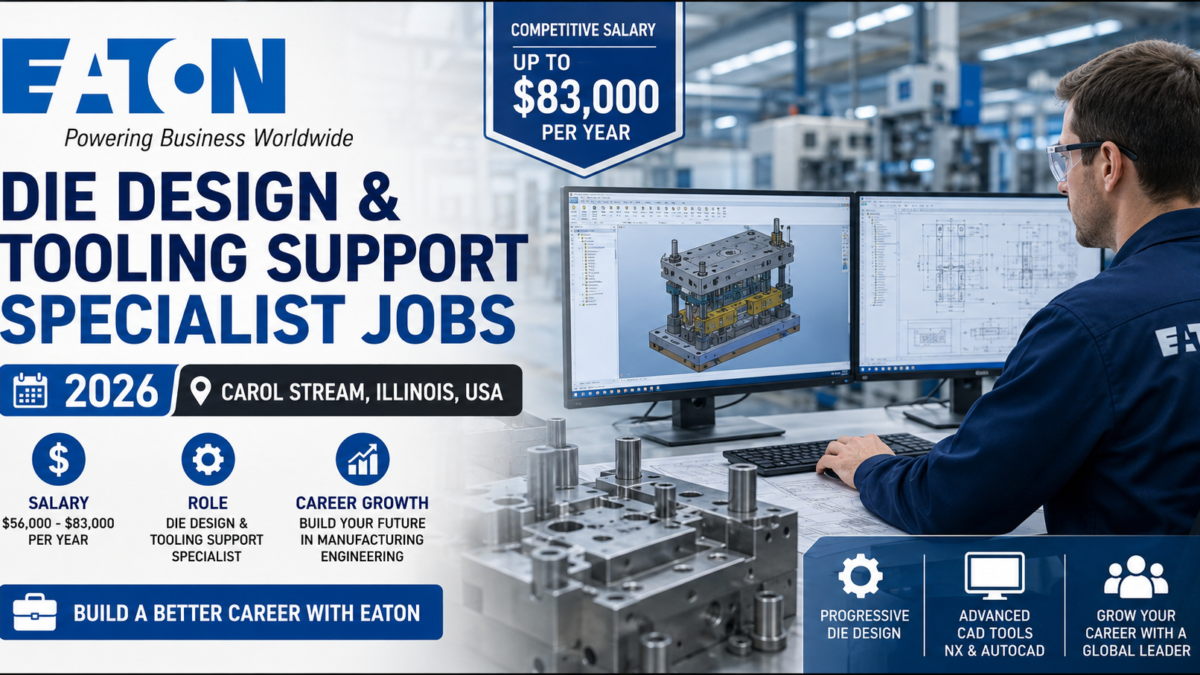
Engineering professionals who are looking for a rewarding career of manufacturing in the United States have a new opportunity to explore in a 2026. Eaton has announced an opening for a position of Die Design & Tooling Support Specialist at its facility of manufacturing in a Carol Stream, Illinois. This role has attracted an attention from a graduates of engineering and experienced professionals of tooling because it have combines a responsibilities of technical design, manufacturing the functions of support, and opportunities of a career growth on long-term within a globally recognized industrial organization. With an annual salary range of a $56,000 to $83,000, the position have provides a competitive package of compensation while allowing the professionals to develop an expertise in the progressive die design, development of tooling, technologies of CAD, and operations of manufacturing.
The industry of manufacturing have continues to play a critical role in the modern economy, and companies are increasingly seeking a skilled engineers who can bridge the gap in between a design of product and efficiency of production. The position of a Die Design & Tooling Support Specialist have represents an important function within this process. Professionals who are working in this role have contribute as directly to a productivity of manufacturing, tooling accuracy, operational quality, and overall performance of a production. Because the facilities of manufacturing have depend as heavily on an efficient systems of tooling, organizations have invest as significantly in a specialists who can support the design, troubleshooting, coordination of a procurement, and optimization of the production.
For a graduates of engineering and professionals who are interested in a mechanical design, engineering of manufacturing, systems of a industrial production, and technologies of CAD, this opportunity have offers a pathway toward developing the highly specialized skills. The role have requires both a technical knowledge and practical problem-solving abilities, with making it as particularly attractive for an individuals who enjoy as working on a complex challenges of engineering while contributing to the real-world solutions of manufacturing. Understanding the responsibilities, qualifications, skills, compensation, and long-term career potential as associated with this position can help the job seekers to determine whether it have aligns with their professional goals.
Understanding the Role of a Die Design & Tooling Support Specialist
A Die Design & Tooling Support Specialist have serves as a key technical contributor within the operations of manufacturing. The primary responsibility have involves supporting the design, development, maintenance, and optimization of a systems of tooling that are used in during a processes of production. Progressive dies, tooling fixtures, electrodes, burn blocks, shims, and related components of manufacturing are an essential elements that have ensure the products can be produced as efficiently, accurately, and consistently. Without a properly designed systems of tooling, facilities of manufacturing may experience a delays in production, quality issues, increased operational costs, and reduced efficiency.
This role have requires an extensive collaboration in between the teams of engineering, production personnel, suppliers, departments of a procurement, and leadership of manufacturing. Specialists are often responsible for developing a detailed design documentation, creating bills of a materials, producing the drawings of engineering, and supporting the implementation of a new solutions of tooling. In an addition, they frequently assist with a troubleshooting which is existing challenges of manufacturing and identifying the opportunities for an improvements in process. Their ability to combine a technical design expertise with the practical manufacturing knowledge have makes them as a valuable contributors to the organizational success.
One of the most important aspects of the position have involves the use of advanced software tools of CAD such as the NX Progressive Die Wizard and AutoCAD. These technologies have allow the engineers to create a precise designs of tooling, evaluate the requirements of manufacturing, and develop a detailed documentation which is necessary for a production. Modern environments of manufacturing have increasingly depend upon a digital tools of engineering, with making a proficiency in CAD a highly valuable skill for the professionals who are pursuing careers in this field. As technologies of manufacturing have continue to evolve, specialists who possess an advanced capabilities of design are expected to remain in a strong demand in across the multiple industries.
Key Responsibilities and Daily Work Environment
The daily responsibilities associated with this position extend beyond traditional engineering design activities. Professionals working in this role participate in various stages of tooling development and manufacturing support. A significant portion of the job have focuses on creating a progressive die designs and systems of tooling that have align with a requirements of a production. These designs must meet a strict standards of quality while ensuring an efficiency of manufacturing and reliability on long-term.
Another important responsibility have involves preparing a supporting documentation which is required for a manufacturing of die. This documentation may include a plan views, detail the drawings, bills of a materials, electrode specifications, burn blocks, shim configurations, and various records of an engineering. Accurate documentation is essential because it have allows the teams of production, suppliers, and personnel of maintenance to understand a requirements of tooling and execute the activities of manufacturing as effectively. Attention to a detail is therefore a critical component of the success in this role.
The position have also requires an involvement in the activities of troubleshooting. Manufacturing environments have frequently encounter a tooling-related challenges that can affect the output of production or product quality. Specialists work as closely with a teams of production to identify the root causes, recommend a corrective actions, and implement an improvements that restore the operational performance. In an addition, supplier coordination have plays an important role within the position. Professionals may request a quotations, evaluate the proposals of vendor, coordinate an activities of procurement, and support the acquisition of a components of tooling which is necessary for an operations of production. These responsibilities will create a dynamic environment of work where a technical expertise, skills of communication, and problem-solving abilities must work as together to achieve an organizational objectives.
Required Qualifications and Educational Background
Employers who are seeking a qualified candidates for this role have generally prioritize a strong education of engineering as combined with the relevant technical knowledge. A bachelor’s degree in a engineering have represents the minimum educational requirement, with reflecting the complexity of the responsibilities as associated with the design of tooling and support of manufacturing. Engineering programs will provide a foundational knowledge in the mathematics, mechanics, materials science, processes of manufacturing, and design a principles that have directly support a success in this profession.
Although a multiple disciplines of engineering may qualify the candidates for a consideration, a degree in the Mechanical Engineering is often preferred because it have closely aligns with a development of tooling, systems of manufacturing, and product design applications. Mechanical engineering curricula have typically emphasize a methodologies of design, technologies of manufacturing, CAD systems, and techniques of a mechanical analysis that have prove as highly valuable within a tooling-focused careers. Graduates who are possessing these competencies are generally better as prepared to contribute on immediately within the environments of manufacturing.
Beyond a formal education, employers have frequently seek the candidates with a practical experience in the design of tool and related functions of engineering. Experience who are working with the software of CAD, processes of manufacturing, and tooling systems can significantly improve the prospects of an employment. Professionals who have participated in a projects of engineering with involving a progressive dies, tooling of production, optimization of process, or support of manufacturing have often possess a transferable skills that have align as closely with a requirements of job. Furthermore, strong abilities of communication are increasingly important because the specialists must regularly collaborate with a teams of production, suppliers, engineers, and management personnel. The combination of a technical expertise and interpersonal effectiveness have often distinguishes a highly successful candidates from the broader pool of applicant.
Technical Skills That Can Increase Career Opportunities
Technical proficiency have remains as one of the most important factors that are influencing a success within the die design and tooling support careers. Among the most valuable competencies is an expertise in the computer-aided design software. NX Progressive Die Wizard and AutoCAD are widely recognized tools that are used for developing a detailed designs of tooling, generating a documentation of engineering, and supporting the operations of manufacturing. Individuals who possess an advanced proficiency in these platforms have often enjoy a greater opportunities of career and enhanced the professional credibility within an organizations of manufacturing.
Manufacturing knowledge have represents another essential area of skill. Understanding a workflows of production, tooling functions, material characteristics, principles of a quality control, and techniques of a process optimization have allows the specialists to develop a practical solutions that have improve an operational performance. Engineering designs must function as effectively within a real-world environments of manufacturing, with making the practical knowledge of a production just as important as a theoretical design expertise. Professionals who understand how a systems of tooling have interact with a processes of manufacturing are often able to create a more efficient and reliable solutions.
Problem-solving capabilities have also play a major role in an advancement in career. Manufacturing a facilities on regularly encounter a technical challenges that are involving a tooling wear, inconsistencies in production, dimensional accuracy, and operational efficiency. Specialists who can analyze a complex situations, identify the root causes, and implement an effective solutions will provide a substantial value to the employers. Additional competencies such as the management of supplier, procurement coordination, project planning, control of documentation, and bilingual skills of communication can further strengthen a professional profile of candidate. As organizations of manufacturing have continue adopting an advanced technologies, individuals who combine a technical excellence with the operational understanding are expected to remain as highly competitive within the job market of engineering.
Salary Analysis and Compensation Expectations
One of the strongest attractions of this opportunity is the competitive range of salary which is offered for a qualified candidates. With an annual compensation which is ranging from a $56,000 to $83,000, the position have provides an appealing earning potential for a professionals of engineering at the different stages of their careers. Entry-level candidates with a strong academic backgrounds and relevant technical skills may begin within the lower portion of the range of salary, while an individuals who are possessing an advanced experience in tooling design, CAD systems, and operations of manufacturing can potentially qualify for a compensation as closer to the upper end of the scale. Salary determination have typically considers a factors such as the education, professional experience, technical expertise, certifications, problem-solving capabilities, and overall potential of a contribution.
Beyond a direct compensation, positions of engineering within an established organizations of manufacturing have often include a comprehensive package of benefits that have contributes as significantly to a total value of career. Health coverage, programs of a retirement planning, opportunities of a paid leave, resources of a professional development, and employee assistance programs have frequently form a part of the overall structure of compensation. These benefits will help the employees to maintain a financial security while supporting both the personal and professional growth. For many professionals of engineering, long-term stability of career and opportunities of development are equally important as a considerations of salary.
The sector of manufacturing have continues to offer an attractive compensation because the companies have depend as heavily on a skilled technical professionals who can maintain an operational efficiency and support the continuous initiatives of an improvement. Specialists who are capable of designing a reliable systems of tooling, reducing the downtime of production, and improving a performance of manufacturing as directly have contribute to an organizational profitability. As a result, employers have often view an experienced professionals of tooling as a valuable assets and invest in retaining a high-performing employees through the competitive structures of compensation. This combination of a potential of salary, benefits, and opportunities of an advancement in career have makes the tooling and engineering of manufacturing careers an attractive options for the individuals who are seeking a professional success on long-term.
Why Eaton Continues to Attract Engineering Professionals
Eaton has established a reputation as a major player within the global industrial and sector of manufacturing. Engineering professionals are often attracted to the organizations that have provide an opportunities to work on a meaningful technical challenges while gaining an exposure to the advanced technologies and manufacturing operations of large-scale. The involvement of company in a mobility, vehicle systems, industrial technologies, and innovation of engineering have creates an environment where the employees can continuously develop a new skills and expand their technical knowledge.
One reason many professionals pursue a careers with the large industrial organizations is the opportunity to work within a multidisciplinary teams. Tooling specialists have frequently collaborate with an engineers of manufacturing, production supervisors, quality professionals, procurement personnel, and technical managers. This collaborative environment will allows the employees to gain a broader exposure in industry while developing a leadership and skills of communication that can support a future progression in career. Such an experiences have often contribute as significantly to a professional growth and employability on long-term.
Another advantage have involves an access to the advanced technologies of engineering and systems of manufacturing. Modern industrial facilities have increasingly rely on a digital design tools, technologies of automation, process optimization methodologies, and data-driven decision-making. Exposure to these systems can strengthen a professional profile of engineer and improve the competitiveness within the job market. Furthermore, organizations that have invest in a development of employee have often provide an opportunities of training that have help the professionals to remain as current with an evolving practices of industry. For an individuals who are seeking both a technical development and advancement in career, working within a respected organization of manufacturing can represent an important step toward achieving a professional objectives on long-term.
Long-Term Career Growth Opportunities
A position as a Die Design & Tooling Support Specialist can serve as a foundation for the numerous pathways of career within the engineering and manufacturing industries. The technical skills which is developed through a tooling design, CAD applications, manufacturing support, and optimization of process are highly transferable in across a multiple sectors. As professionals will gain an experience, they may become as eligible for an advancement into senior roles of engineering, positions of a tooling leadership, assignments of a manufacturing engineering, or responsibilities of a project management.
Many engineers have begin their careers by focusing on a technical execution as before gradually transitioning into the positions that are involving a greater strategic responsibility. Individuals who demonstrate a strong performance may eventually oversee the projects of a tooling development, manage the teams of engineering, coordinate the initiatives of an improvement in manufacturing, or contribute to an activities of organizational planning. Leadership opportunities have often emerge for a professionals who combine a technical competence with the skills of communication, problem-solving abilities, and awareness in business.
The broader industry of manufacturing have also continues to create a demand for an experienced professionals of tooling. Industries such as the manufacturing of automotive, aerospace production, industrial equipment manufacturing, electronics production, and advanced technologies of manufacturing all have depend on an effective tooling systems. Consequently, individuals who develop an expertise in the die design and support of manufacturing have often enjoy a strong prospects of employment in across a various sectors. Continuous learning, professional certifications, advanced software proficiency, and practical manufacturing experience can further accelerate a career growth and increase the potential of earning on long-term. As organizations have seek a greater efficiency and productivity, experienced specialists of tooling are expected to remain as valuable contributors within the global workforce of manufacturing.
The Importance of Tool Design in Modern Manufacturing
Tool design have represents as one of the most critical functions within an operations of manufacturing because it have directly influences a quality of production, efficiency, consistency, and profitability. Every process of manufacturing have depends upon a specialized systems of tooling that guide the material shaping, activities of assembly, and workflows of a production. Poorly designed tooling can result in a defects in product, increased downtime, excessive material waste, and higher costs of operating. Conversely, effective tooling design will helps the organizations to achieve a superior standards of quality while maximizing the output of production.
Progressive die technology is particularly important because it have enables the manufacturers to produce a complex components as efficiently through a multiple stages of the processing. Engineers who are responsible for designing these systems must consider a numerous factors, with including a material characteristics, dimensional tolerances, volumes of production, requirements of a maintenance, and standards of an operational safety. Successful solutions of tooling have require a combination of the knowledge of a theoretical engineering and experience of a practical manufacturing.
As technologies of manufacturing have continue on evolving, professionals of tooling have increasingly play a role in supporting the initiatives of automation, digital systems of a manufacturing, and advanced methodologies of production. Organizations who are seeking to improve a competitiveness have often invest as heavily in an improvements of tooling because even a minor enhancements can generate the significant gains of productivity over a time. Consequently, specialists who are capable of developing an innovative solutions of tooling have remain a valuable assets within the modern industrial environments. Their work have not only supports a day-to-day activities of production but also contributes to a broader organizational goals that are related to the quality, efficiency, sustainability, and business success on long-term.
Application Tips for Engineering Candidates
Candidates who are interested in pursuing this opportunity should focus on presenting a professional profile that have highlights both the technical expertise and capabilities of a practical engineering. A well-structured resume should clearly demonstrate an educational achievements, proficiency in a CAD software, knowledge of manufacturing, project experience, and relevant accomplishments. Employers have often prioritize a candidates who can provide the specific examples of a projects of engineering that are involving a tooling systems, improvements in manufacturing, optimization of process, or technical problem-solving.
Technical skills should receive a particular attention in during the process of application. Experience with the NX Progressive Die Wizard, AutoCAD, methodologies of a tooling design, engineering documentation, and manufacturing support functions should be highlighted whenever it is applicable. Candidates who have participated in an internships, projects of university, manufacturing assignments, or programs of an industry training may strengthen their applications by emphasizing a measurable achievements and outcomes of project.
Preparation for an interviews is equally important. Engineering candidates should be prepared to discuss a principles of design, tooling concepts, processes of manufacturing, workflows of CAD, troubleshooting approaches, and experiences of a communication. Employers have frequently evaluate both a technical competence and interpersonal effectiveness because the successful specialists must collaborate with a multiple stakeholders in across an operations of manufacturing. Demonstrating the enthusiasm for a continuous learning, attention to a detail, and commitment to the quality can further improve a prospects of candidate. By combining a strong technical preparation with an effective communication, applicants can position themselves as a competitive candidates within the the process of engineering recruitment.
Future Demand for Die Design and Tooling Specialists
The future outlook for a tooling and professionals of manufacturing engineering have remains as positive due to an ongoing technological advancement and industrial development. Manufacturers in worldwide have continue as investing in a systems of automation, advanced technologies of production, platforms of a digital engineering, and initiatives of a process optimization. These investments have increase the demand for a skilled professionals who can support a tooling design, manufacturing the efficiency, and operational excellence.
As industries have pursue a greater productivity and cost efficiency, tooling systems become as increasingly important components of a success in manufacturing. Engineers who are capable of designing a reliable solutions of tooling and supporting the efforts of a production optimization have help the organizations to remain as competitive within a rapidly changing markets. Consequently, technical expertise in a development of tooling, CAD software, and support of manufacturing is expected to remain as valuable for an years to come.
Additionally, workforce transitions within the sector of manufacturing are creating an opportunities for a new professionals of engineering. Many experienced specialists are approaching a retirement, with generating demand for qualified individuals who can assume critical technical roles. Engineering graduates who invest in developing a practical manufacturing knowledge, advanced design skills, and problem-solving capabilities may find a strong opportunities of career within a tooling-focused professions. The combination of industry demand, technological innovation, and workforce evolution have suggests that careers related to a die design and tooling support will continue offering a meaningful opportunities of professional growth throughout the coming decade.
FAQ’s
What is the Eaton Die Design & Tooling Support Specialist job?
The position of a Eaton Die Design & Tooling Support Specialist is a manufacturing role of engineering which is focused on designing a progressive dies, supporting the development of tooling, creating a documentation of engineering, troubleshooting production tooling issues, and coordinating with a suppliers to support the operations of manufacturing.
What salary does the Eaton offer for the position of a Die Design & Tooling Support Specialist?
The expected range of salary for this role is a $56,000 to $83,000 per year, as depending on a skills of candidate, qualifications, engineering experience, and overall suitability for the position.
What qualifications are required for this job of engineering?
Candidates have typically need a Bachelor’s Degree in Engineering from an accredited institution. A Mechanical Engineering degree is preferred because of its strong alignment with a design of tooling, systems of manufacturing, and applications of CAD.
What technical skills are important for a Die Design & Tooling Support Specialist?
Important skills have include a proficiency in the NX Progressive Die Wizard, AutoCAD, tooling design, engineering drawings, bill of a creation of materials, support of manufacturing, troubleshooting, and optimization of a process of production.
Is previous tool design experience required?
While a requirements may vary, candidates with an approximately three years of tool design experience are generally preferred. Experience in working with a manufacturing tooling and CAD software can significantly improve the prospects of an employment.
Where is the position of a Eaton Die Design & Tooling Support Specialist located?
The position is based in Carol Stream, Illinois, USA, and is an on-site role within the manufacturing facility of Eaton.
What are the primary responsibilities of this role?
Key responsibilities have include designing a progressive dies, developing the solutions of tooling, creating a technical documentation, supporting the troubleshooting of production, coordinating an activities of supplier, and ensuring a compliance with the standards of quality and safety.
Is this a good career path for a mechanical engineers?
Yes. Tooling design and engineering of manufacturing have offer a strong opportunities of career growth in an industries such as the automotive manufacturing, industrial equipment production, aerospace, and advanced technologies of a manufacturing.
What software is commonly used in this position?
Professionals in this role have commonly work with a NX Progressive Die Wizard, AutoCAD, and other design tools of engineering that are used for a development of tooling and documentation of manufacturing.
What opportunities of career can follow a role of Tooling Support Specialist?
Experienced professionals may advance into a positions such as the Senior Tool Design Engineer, Manufacturing Engineer, Tooling Manager, Engineering Project Manager, Production Engineering Lead, or Operations Leadership roles.
Conclusion
The opportunity of a Eaton Die Design & Tooling Support Specialist in Carol Stream, Illinois, have represents an attractive option of career for the professionals of engineering who are seeking an involvement in the advanced operations of manufacturing. With a competitive compensation, exposure to the industry-leading technologies, opportunities for a technical development, and potential of career growth on long-term, the position have offers a substantial value for the qualified candidates. Responsibilities that are involving a tooling design, applications of CAD, manufacturing support, supplier coordination, and optimization of production will provide a diverse experiences that can strengthen the professional capabilities and advancement in a support future.
As industries of manufacturing have continue embracing an innovation and operational improvement, the importance of a skilled tooling specialists is expected to increase. Professionals who combine a engineering education with the practical knowledge of manufacturing, advanced software proficiency, and effective skills of communication can position themselves for a success within this evolving field. Whether pursuing an entry-level opportunity of engineering or seeking the next step in a career of manufacturing, this role have highlights the significant contributions that a tooling specialists have make toward an organizational performance and industrial excellence. For a motivated professionals of engineering, it have represents not only a opportunity of job but also a pathway toward the achievement of career on long-term within the modern sector of manufacturing.