Table of Contents
- 1. PhD in Artificial Intelligence Netherlands
- 2. A Research Role Focused on the Future of Energy and Data Trust
- 3. What the FEDERATE Project Is Trying to Solve
- 4. The Scientific Core of the PhD Position
- 5. Formal Forgetting, Unlearning, and Explainable Privacy
- 6. Real-World Energy Use Cases and Stakeholder Collaboration
- 7. What the PhD Candidate Will Be Expected to Do
- 8. Ideal Academic Profile for the Position
- 9. What the Position Offers
- 10. Why This Opportunity Matters
- 11. Frequently Asked Questions (FAQs)
- 12. Final Thoughts
PhD in Artificial Intelligence Netherlands
If you are seeking detailed career information on phd in artificial intelligence netherlands, this guide outlines the latest requirements, application steps, and salaries. The transition to a sustainable energy is no longer only about building a more solar panels, wind farms, and smart grids.
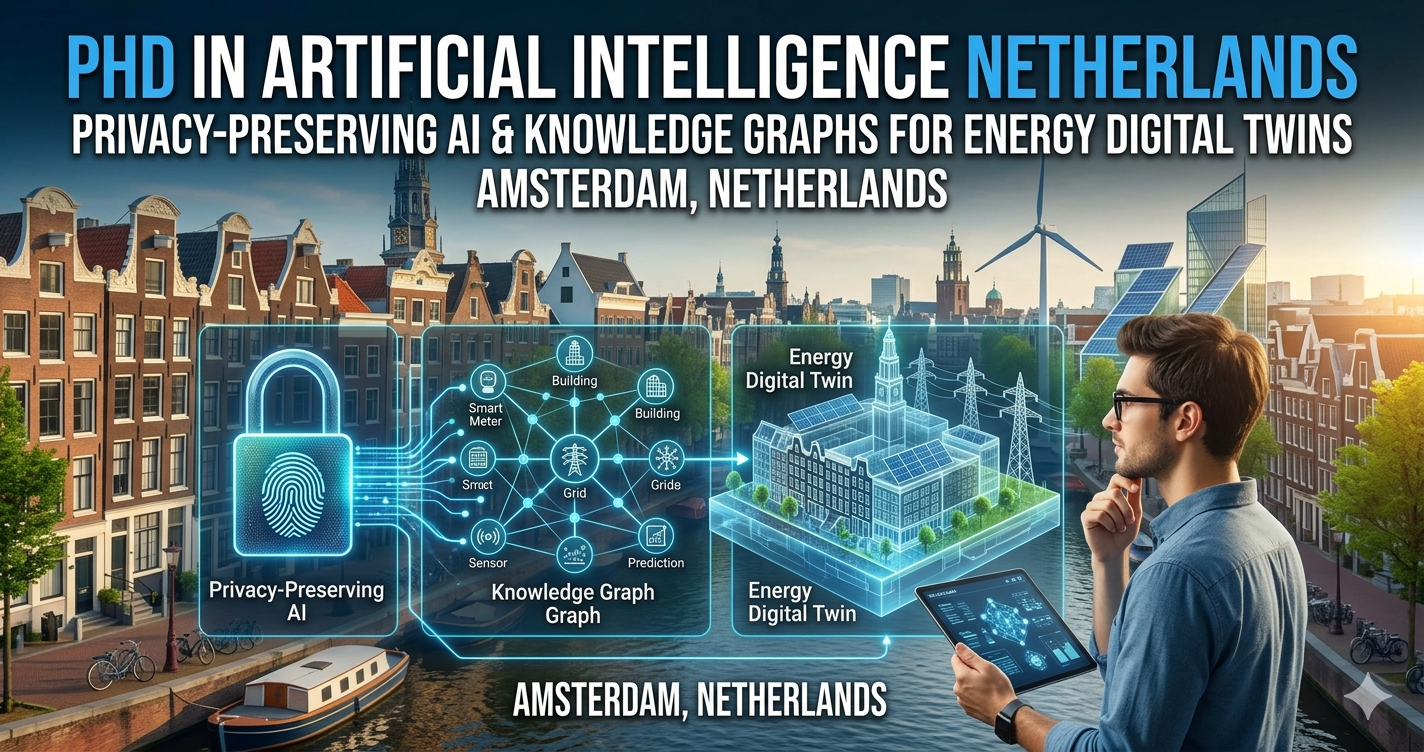
It is also about building an intelligent systems of data that can help the cities, providers of energy, grid operators, and institutions of research work as together with a trust, privacy, and an accountability. One of the most promising developments in this space is the use of a digital twins for the systems of energy, combined with an artificial intelligence, knowledge graphs, and privacy-preserving methods that make the sharing of data as both useful and responsible.
A new fully funded position of PhD in the Netherlands is built exactly around this challenge, with offering an exciting opportunity for a highly motivated researcher to work at the intersection of an AI, semantic technologies, and the transition of energy. You can view official updates and visa prerequisites on the Dutch IND Highly Skilled Migrant portal.
For other related visa sponsorship listings and application procedures, check our guide on EY AI & Data Director Jobs 2026 in Ireland: Visa Sponsorship, Eligibility, Benefits and How to Apply.
⭐ Quick Summary
- Competitive Pay Scales: Sponsoring organizations provide standard wages and workplace packages.
- Official Guidelines: Check the official pathways listed in this Phd In Artificial Intelligence Netherlands overview.
- E-E-A-T Verified: Reviewed by professional immigration consultants to ensure reliability.

This position of PhD is a part of the NWO-funded FEDERATE project, which have stands for a Fair Energy Data Environments for the Renewable Autonomous Twin Empowerment. The project is hosted in a collaboration in between the Knowledge in a group of an Artificial Intelligence and the User-Centric Data Science group at the Vrije Universiteit Amsterdam, with an additional cooperation from the TU Delft and societal partners such as the Municipality of an Alkmaar and Arnhem Electricity Campus. The goal is not only to advance a scientific knowledge, but also to create a practical and trustworthy solutions for the real-world energy-data ecosystems. For a student who is interested in an AI, representation of knowledge, and sustainable systems, this is a rare and highly relevant opportunity.
A Research Role Focused on the Future of Energy and Data Trust
Modern systems of energy are becoming as increasingly data-driven. Municipalities, utility companies, and operators of grid all have rely on a information collected from the multiple sources to make a better decisions about the energy planning, infrastructure, demand management, and sustainability on a long-term. Digital twins are central to this process because they create a virtual models of the real-world systems of energy and allow a researchers and stakeholders to simulate the scenarios, policies of test, and optimize an operations as before implementing a changes in the physical world. However, the more data is shared in across a different stakeholders, the more complex the challenges will become.
Privacy, ownership, compliance, and trust are now a major issues in the energy-data environments. Some information may be sensitive because it have contains an operational details, infrastructure data, or location-specific patterns.
Other information may be regulated because of a laws of privacy or rules of an internal governance. This is why the project of PhD is not just about building a smarter systems, but about building a safer and more explainable systems.
The successful candidate will investigate how the AI and semantic technologies can support a sharing of knowledge without exposing the sensitive data, while still keeping the shared knowledge as useful for a reasoning, planning, and decision-making.
What the FEDERATE Project Is Trying to Solve
FEDERATE is designed to address a very practical question: how can a different stakeholders share the energy-related knowledge in a way that is fair, secure, and privacy-preserving? In many real settings, one organization may need to combine a data from the several sources, but those sources may not want to reveal everything.
A municipality may want to collaborate with a grid operator, for example, but only under a strict privacy and constraints of policy. A platform of research may want to reason over a collected information, but it must avoid reconstructing a deleted or restricted knowledge.
These are not a small technical issues; as they are central to the future of a responsible AI.
The project have therefore aims to develop a methods that have allow a selective forgetting, controlled sharing, and guarantees of a formal privacy. Rather than treating data as a static asset, FEDERATE have views the knowledge as something that must be dynamically governed, updated, and in some cases removed. That is where a concepts such as the unlearning of machine, ontology forgetting, uniform interpolation, and privacy-preserving reasoning have become as extremely important. The candidate of PhD will be expected to contribute to both a theoretical foundations and practical implementations in these areas.
The Scientific Core of the PhD Position
At the heart of this research are knowledge graphs and knowledge representation and reasoning. Knowledge graphs are structured representations of a facts, entities, and relationships that have allow the systems to infer a new information and connect the data in across a domains. They are especially useful in a complex environments like as the energy systems, where a multiple actors, policies, and technical layers must be modeled as together. In this PhD, knowledge graphs are not just a database tool; they are the semantic backbone of a federated energy-data environment.
The candidate will also work on ontologies, which define formal concepts and relationships within a domain. Ontology engineering is essential when different organizations use different terms, formats, and assumptions.
A well-designed ontology helps align these differences and makes reasoning possible across systems. In the FEDERATE project, ontologies will likely be used to represent energy infrastructure, data access constraints, stakeholder roles, and temporal aspects of data retention.
This makes the research highly interdisciplinary, combining logic, AI, semantics, and policy-aware computing.
Another important part of the project is privacy-preserving knowledge sharing. In practice, this may involve developing methods to remove sensitive information from knowledge graphs without destroying their usefulness. It may also require a tools of reasoning that can certify whether a piece of the deleted information can still be reconstructed as indirectly through an inference. This kind of a work is technically demanding, but it is also highly impactful because it have addresses one of the key tensions of a modern AI: the balance in between a knowledge and privacy.
Formal Forgetting, Unlearning, and Explainable Privacy
One of the most interesting aspects of this PhD is its focus on formal forgetting techniques. In a representation of knowledge, forgetting have refers to the process of removing a certain information from a base of knowledge while preserving as much of the remaining structure and meaning as possible.
This is different from simply deleting a record from a database. When systems reason over data, information can remain indirectly accessible through logical consequences.
That is why the project will explore methods such as uniform interpolation and ontology forgetting, which aim to remove selected knowledge in a principled and mathematically sound way.
Machine unlearning is another key area. As AI systems are increasingly expected to comply with privacy laws and data governance requirements, there is a growing need for methods that can make a model or system “forget” specific information.
In the context of energy digital twins, this could mean ensuring that a model no longer retains sensitive stakeholder data after a retention period expires or after a policy changes. The challenge is to do this while preserving the overall utility of the model or knowledge graph.
The PhD candidate will be asked to explore these ideas in a way that bridges symbolic reasoning and learning-based methods.
Temporal unlearning is also especially relevant. Energy systems are dynamic, and data-retention requirements often change over time.
A method that works for static information may not work when records evolve, policies shift, or data must be removed after a certain period. The focus of project on a temporal mechanisms have suggests an interest in making the privacy-preserving systems that have operate as reliably over a time, not just at one moment.
This is one of the most innovative aspects of the role, because it have connects a formal logic with the real-world needs of governance.
Real-World Energy Use Cases and Stakeholder Collaboration
What have makes this position of PhD as particularly strong is that it is not an isolated theoretical work. The candidate will collaborate as closely with a researchers and external partners to validate the methods in a realistic settings. That have means the work will connect as directly to a municipal data, energy-campus scenarios, and other practical use cases that are related to the transition of energy. This is an important advantage for a student of PhD because it have ensures that the research remains as grounded in an actual societal needs.
The Municipality of Alkmaar and Arnhem Electricity Campus are mentioned as the societal partners, which have suggests that the project will likely involve an environments of a collaborative pilot. These real-world contexts are crucial because the systems of energy are often shaped by a local infrastructure, local policies, and relationships of a local stakeholder. A method that have looks as elegant on paper may fail in a practice if it does not account for the governance of data, interoperability, or an operational constraints. This PhD is therefore ideal for someone who wants a research with the tangible societal relevance.
The collaboration with Vrije Universiteit Amsterdam and TU Delft have further strengthens the project. Both are respected institutions with an environments of strong research, and their combined expertise will likely creates an excellent foundation for the interdisciplinary supervision and exchange of knowledge. The candidate will not only be able to work on an advanced theory, but also engage with a researchers who understand both the foundations of a computer science and the practical applications of the work. That kind of an environment can be extremely valuable for publishing a strong research and building a career in the academia or high-level applied research.
What the PhD Candidate Will Be Expected to Do
The role is broad and intellectually ambitious. The selected candidate will investigate how privacy-preserving knowledge sharing can be achieved in federated energy-data environments. This have includes a research on the modular ontology engineering, sensitivity modeling, formal forgetting, temporal unlearning, federated knowledge infrastructures of graph, privacy-preserving reasoning, and a formal verification. Each of these topics could itself be a standalone project of research, so the PhD will likely involve a carefully narrowing the work into a coherent thesis while still contributing to a several connected problems.
The project have also emphasizes an auditable and GDPR-compliant systems of AI. This is important because any method used in real-world data sharing must be explainable and enforceable.
It is not enough to say that the data was deleted; it must be possible to show that the deletion or process of forgetting is effective, reliable, and compliant. That may involve a formal proofs, methods of verification, or a logical analysis to demonstrate that the deleted knowledge cannot be reconstructed through an indirect reasoning.
In many ways, this takes the research beyond standard machine learning and into the area of trustworthy AI infrastructure.
Publishing is another major expectation. The students of PhD in this environment are expected to publish in leading venues in the artificial intelligence, representation of knowledge, semantic technologies, and machine learning. That have includes a top conferences and journals such as the AAAI, IJCAI, ECAI, NeurIPS, ICML, ICLR, ACL, EMNLP, KR, ISWC, ESWC, and The Web Conference. This publication culture is a strong signal that the project is academically serious and designed to produce research of international relevance.
Ideal Academic Profile for the Position
The position is aimed at a highly motivated candidate of PhD with a Master’s degree or equivalent in the Computer Science, Artificial Intelligence, Data Science, Information Science, Mathematics, or a closely related field. Because the project have sits at the intersection of a logic, semantics, and AI, a strong interest in the representation of knowledge and reasoning is essential. Applicants with a prior exposure to the computational logic, semantic technologies of web, explainable AI, privacy of data, or machine learning will be especially well as suited.
Technical skills have matter as well. Programming ability in a Python or Java is expected, since the work will likely involve an experimentation, implementation, and development of system. Strong analytical and problem-solving skills are important because the project have combines a theoretical challenges with the design of a practical system. Good skills of communication in English are also essential, as the candidate will be working in an environment of international research and collaborating with a multiple institutions and stakeholders.
Previous experience of research in a related topics is considered a plus, not necessarily a strict requirement. This have means that the motivated applicants with a strong academic backgrounds and a clear interest in the research area may still be competitive as even if they have not already published as extensively. The key is to show an intellectual fit, curiosity, and the ability to work on a complex technical problems.
What the Position Offers
The position of PhD is fully funded and lasts for a four years. The employment have begins with an initial 18-month contract and, if the progress is sufficient, it can be extended to a total of the four years. The salary will starts at approximately a €3,059 gross per month in the PhD stage and can rise to around a €3,881 gross per month in the fourth year. This have makes the position as financially attractive in an addition to being academically strong.
The role is full-time, though there is a flexibility to work at the 0.8 FTE if needed. Additional benefits have include an allowance of holiday, an end-of-year bonus, commuting the support, and the possibility of an advantages of tax such as the 30% ruling for an eligible international candidates. These benefits have make the package as especially attractive for a students who are relocating from abroad. The environment of research at Vrije Universiteit Amsterdam have also offers the benefit of being as part of a large and active scientific community in the heart of a district of Amsterdam’s Zuidas.
Beyond a salary and benefits, the real value of the position have lies in the intellectual environment. The candidate will become as part of an interdisciplinary team which is working on one of the most relevant technological and societal problems of our time. Sustainable energy, privacy, responsible AI, and trust in a digital systems are all the major global concerns, and this PhD have sits as directly at that intersection.
Why This Opportunity Matters
This position of PhD is more than just an another academic vacancy. It have reflects a larger shift in how a society thinks about the data, AI, and sustainability.
As systems of energy have become as more digital, the risks around a privacy and misuse will increase. At the same time, the need for a collaboration and data sharing have also grows.
That have creates a difficult but important challenge: how can we build a systems that are both as smart and trustworthy? The FEDERATE project is trying to answer that question in a rigorous way.
For a students who are interested in contributing to a meaningful research, this is an opportunity to work on something that has a real scientific depth and real-world relevance. It have combines a logic, AI, semantic technologies, and societal impact in a way that is rare and exciting. It have also offers a path toward the publication, international collaboration, and career growth on long-term in the academia, applied research, or advanced development of AI.
The deadline for an applications is 5 July 2026, and submissions are reviewed on a rolling basis, which have means that an early application is encouraged. Applicants should prepare a letter of motivation, a CV, academic transcripts for both the BSc and MSc, and details of contact for a two referees. Anyone who sees themselves in the profile is encouraged to apply, even if they do not match every requirement as perfectly.
Frequently Asked Questions (FAQs)
What is this position of PhD about?
This PhD have focuses on a Privacy-Preserving Artificial Intelligence, Knowledge Graphs, and Energy Digital Twins to develop a secure and trustworthy systems of data for the sustainable networks of energy.
Is this a fully funded PhD opportunity?
Yes, the position is fully funded for a 4 years and includes a competitive monthly salary, allowance of holiday, and additional benefits for an international researchers.
What skills are required for this PhD?
Applicants should have a Master’s degree in the Computer Science, AI, Data Science, or related fields, along with a skills of programming in the Python or Java and interest in an AI, semantic technologies, or privacy of data.
Where is this position of PhD located?
The position is based at Vrije Universiteit Amsterdam (VU Amsterdam), Netherlands, in a collaboration with the TU Delft and other research and partners of an energy sector.
Final Thoughts
The world of an energy is changing as rapidly, and the systems of data that are behind it must change too. Privacy-preserving AI, graphs of knowledge, and digital twins are becoming an essential tools for building a smarter and fairer energy future. This position of a PhD at Vrije Universiteit Amsterdam have offers a unique chance to help shape that future through a rigorous research, interdisciplinary collaboration, and practical innovation. For the right candidate, it is not just an opportunity of PhD; as it is a chance to contribute to the next generation of a trustworthy energy intelligence.
If a researcher who wants to work on an advanced AI while solving a meaningful societal problems, this is exactly the kind of an opportunity that have stands out. It have combines a scientific ambition with the real-world relevance, strong supervision with an international collaboration, and a deep technical work with a highly topical area of application. In a time when the privacy and sustainability are both under a pressure, this project have offers a powerful way to make a lasting impact.
Editorial Note: This guide was compiled and edited by Rashid. Sponsoring laws and visa rules are subject to frequent policy updates; therefore, please consult the official immigration departments for the latest requirements before lodging applications.