Table of Contents
- 1. Job Overview – Clinical Specialist jobs UK Healthcare Sector
- 2. About Inomed Neurocare & Intraoperative Neuromonitoring (IONM) Services
- 3. Role Responsibilities and Daily Duties of Clinical Specialist
- 4. Required Qualifications, Skills & Eligibility Criteria
- 5. Salary Package, Benefits & Visa Sponsorship Details
- 6. Training Program for Trainee Clinical Specialist Candidates
- 7. Career Growth Opportunities in Neurophysiology Field
- 8. Working Environment in UK Hospitals & Surgical Teams
- 9. Application Process for Clinical Specialist Jobs in UK
- 10. FAQ
- 11. Final Thoughts on Healthcare Career in UK 2026
Job Overview – Clinical Specialist jobs UK Healthcare Sector
If you are seeking detailed career information on clinical specialist jobs uk, this guide outlines the latest requirements, application steps, and salaries. The sector of healthcare in the United Kingdom have continues to expand as rapidly, especially in a specialized medical fields such as the neuroscience, neurophysiology, and intraoperative monitoring.
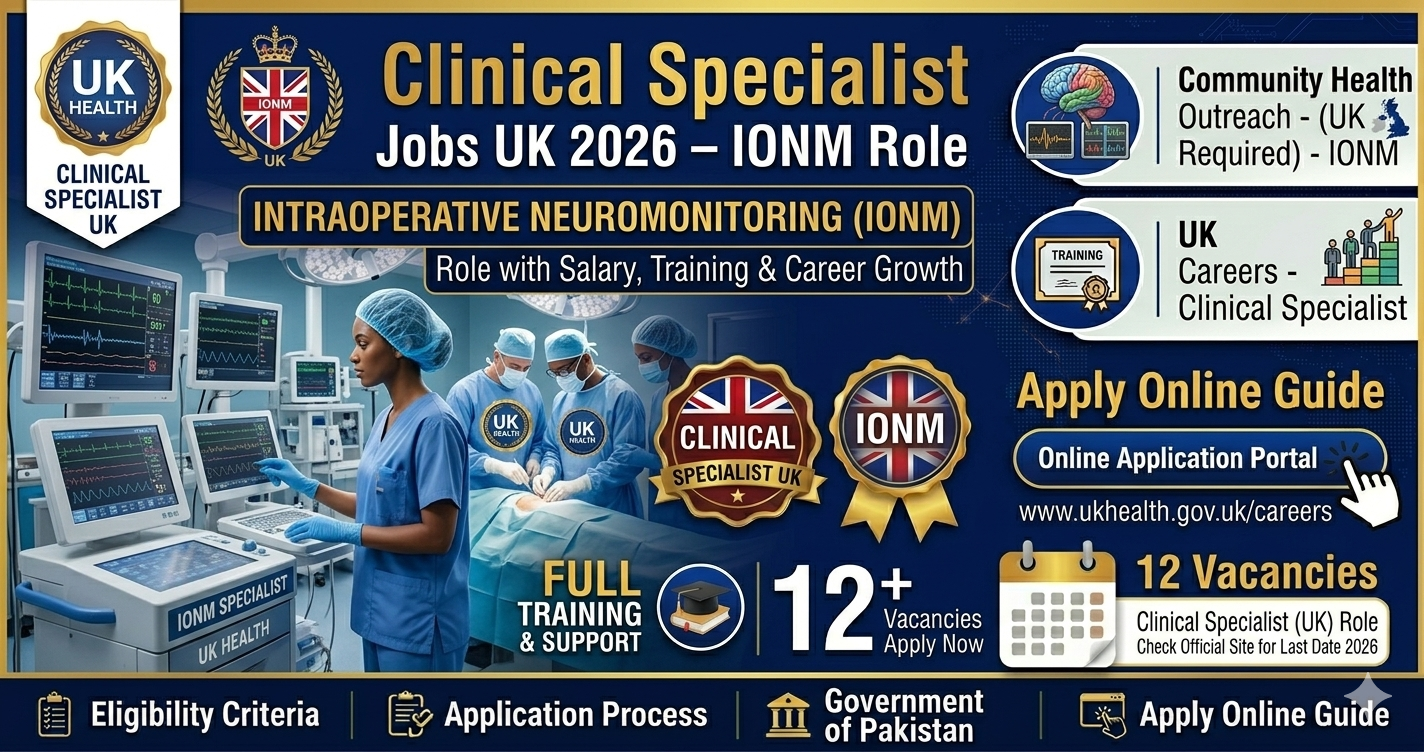
One of the most in-demand roles in this advanced sector is the position of a Clinical Specialist or Clinical Specialist Trainee in Intraoperative Neuromonitoring (IONM). This role is designed for an individuals who are passionate about the brain science, surgical safety, and a real-time monitoring of patient in during a complex medical procedures.
In 2026, the UK healthcare system is actively recruiting a skilled and semi-skilled professionals in this field due to an increasing surgical demands and technological advancements in the operating theatres. You can view official updates and visa prerequisites on the official UK Government Work Visa portal.
For other related visa sponsorship listings and application procedures, check our guide on Qualified Hairdresser Job in Australia – Full-Time Career Opportunity with $78,000 Salary + Visa Sponsorship.
⭐ Quick Summary
- Competitive Pay Scales: Sponsoring organizations provide standard wages and workplace packages.
- Official Guidelines: Check the official pathways listed in this Clinical Specialist Jobs Uk overview.
- E-E-A-T Verified: Reviewed by professional immigration consultants to ensure reliability.

The position of a Clinical Specialist / Trainee is not a general job in hospital; as it is a highly specialized clinical role that have requires a precision, analytical thinking, and a strong collaboration with the surgical teams. Professionals in this role are responsible for monitoring the nervous system of a patients in during the surgeries such as a spinal operations, brain surgeries, vascular procedures, and orthopaedic interventions. This job have ensures that any neurological risk in during a surgery is detected as immediately, with allowing the surgeons to make a quick decisions that protect the safety of patient. Because of its importance, this role is highly respected and offers a strong stability of career in the UK healthcare system.
From the perspective of an employment, this role is also attractive because it have offers a competitive salary packages ranging from £35,000 to £45,000 per year, along with the bonuses of performance, training programs, and in some cases visa sponsorship opportunities for an international applicants. It is suitable for both an experienced professionals and fresh graduates who are willing to enter the field as a trainees and grow into a fully qualified clinical specialists through the programs of a structured training. This have makes it as one of the most promising medical career paths in the UK for 2026.
About Inomed Neurocare & Intraoperative Neuromonitoring (IONM) Services
Inomed Neurocare is one of the leading healthcare service providers in the United Kingdom who are specializing in a Intraoperative Neuromonitoring (IONM). The organization have plays a critical role in supporting the hospitals and surgical teams by providing an advanced neurophysiological monitoring services in during the surgeries. The main objective of an Inomed Neurocare is to enhance the safety of patient and improve a surgical outcomes by ensuring a real-time monitoring of the nervous system activity in during a high-risk operations.
IONM technology is a highly advanced medical system that have allows the specialists to monitor the brain, spinal cord, and peripheral nerves in during a surgery. This system have helps in detecting any potential neurological damage before it becomes as irreversible. The technology have uses a multiple diagnostic modalities such as the EEG (Electroencephalography), EMG (Electromyography), SSEPs (Somatosensory Evoked Potentials), MEPs (Motor Evoked Potentials), BAEPs (Brainstem Auditory Evoked Potentials), and VEPs (Visual Evoked Potentials). These tools have collectively provide a complete picture of the neurological status of a patient in during the surgical procedures.
Inomed Neurocare is widely recognized for maintaining a high standards of the clinical excellence, accuracy, and patient care. The company have works as closely with a surgeons, anesthetists, and hospital staff to ensure a seamless integration of the neuromonitoring into a surgical workflows. One of the key strengths of the organization is its focus on a continuous professional development, with offering a programs of training, mentorship, and opportunities of a career progression for its clinical staff. This have makes it an ideal workplace for the individuals who want to build a long-term career in the neurophysiology and surgical monitoring.
Role Responsibilities and Daily Duties of Clinical Specialist
The role of a Clinical Specialist or Trainee in Intraoperative Neuromonitoring is highly technical and requires a strong attention to detail. Professionals in this position are responsible for ensuring the safe monitoring of a nervous systems of patients in during the surgery. This have involves as working directly inside the operating theatres and collaborating as closely with a surgical teams in the real time.
One of the primary responsibilities have includes the setup and operation of an advanced neuromonitoring equipment before the surgery begins. This have involves placing a needle electrodes on the patient and ensuring that all the systems are calibrated correctly for an accurate collection of data. During a surgery, the clinical specialist have continuously monitors a neurophysiological signals and interprets the changes that may indicate a potential neurological risk. If any abnormal activity is detected, an immediate communication is made to the surgeon so that a necessary adjustments can be taken without any delay.
Another critical responsibility is the analysis of a real-time data which is collected through the monitoring systems. The specialist must understand a complex waveforms and neurological signals to determine that whether the nervous system of patient is functioning as properly. This have requires a strong analytical skills and a deep understanding of the neurophysiology. Additionally, an accurate documentation is essential, as all findings must be recorded in a detailed reports for the medical and legal purposes.
The role have also involves working in a highly dynamic environment where the surgeries can last a several hours. Clinical specialists are required to remain as alert and focused throughout the entire procedure. They must also manage a pre-operative preparations and post-operative reporting duties. Communication have plays a key role in this job, as specialists must interact as continuously with the surgeons, anesthetists, and theatre staff to ensure the safety of patient and smooth surgical operations.
Required Qualifications, Skills & Eligibility Criteria
To qualify for a position of Clinical Specialist in the UK, candidates must have a strong academic background in the neuroscience or a related scientific field. Typically, a Master’s or Doctorate degree in neuroscience, neurophysiology, biomedical science, or a similar discipline is required for the role of specialist. However, individuals with a less experience or recent graduates may be considered for the position of Trainee, where a full training is provided.
Experience in the intraoperative neuromonitoring is highly preferred for a specialist roles, which is usually requiring at least one year of the hands-on clinical experience. However, trainees without a prior experience are also encouraged to apply, as structured programs of training are designed to develop their skills from the ground up. Strong technical abilities, analytical thinking, and attention to detail are essential for a success in this field.
Candidates must also possess an excellent skills of communication, as they will be working closely with a multidisciplinary medical teams. The ability to remain as calm under pressure is crucial, which is especially in during a long and complex surgical procedures. Fluency in the English is required for an effective communication within the environment of healthcare. Additionally, willingness to travel in across a different locations of hospital in the UK is often necessary which is depending on the requirements of assignment.
From a perspective of personal skill, individuals must demonstrate a strong interest in the neuroscience and medical technology. Adaptability, teamwork, and continuous learning are highly valued traits in this profession. Since environmentsof healthcare have operate around the clock, candidates should also be willing to work on irregular hours, which is including an early mornings, late evenings, and on-call weekend shifts.
Salary Package, Benefits & Visa Sponsorship Details
One of the most attractive aspects of the Clinical Specialist / Trainee role in an Intraoperative Neuromonitoring (IONM) in the United Kingdom is the competitive structure of a salary which is combined with a strong benefits of employee. In 2026, professionals in this field can expect a salary range in between a £35,000 and £45,000 per year, which is depending on the experience, qualifications, and job role level (specialist or trainee). In an addition to the base salary, many employers have also offer a performance-based bonus scheme that can increase a total annual earnings by an approximately 30% to 40%, which is making this role as financially rewarding as compared to many other positions of entry-level healthcare.
Beyond a salary, the role have includes a several additional benefits which is designed to support a long-term career stability and well-being of employee. These often include a private healthcare insurance, pension contributions, paid sick leave, and continuous professional development programs. In some cases, international applicants may also receive a visa sponsorship support, which is making this opportunity as accessible to a qualified candidates in outside the UK. This is particularly important for a healthcare professionals from the countries like as Pakistan, India, and other regions where a pathways of skilled migration to the UK are in a high demand.
Another key benefit is a job security within the sector of healthcare. Since an intraoperative neuromonitoring is a specialized and essential service in a surgical procedures, demand for a qualified professionals have remains as consistently high. This have ensures an employment stability on long-term and opportunities of a career growth. Additionally, professionals have gain an exposure to advanced medical technologies and work in a highly respected environments of hospital, which have further enhances their global career prospects in a neuroscience and clinical neurophysiology.
Training Program for Trainee Clinical Specialist Candidates
For a candidates who join as the Trainee Clinical Specialists, the UK healthcare system have provides a structured and comprehensive training program which is designed to develop a technical and clinical expertise in the intraoperative neuromonitoring. This training is essential because the field have requires a strong understanding of the neurophysiology, surgical procedures, and interpretation of data on real-time. The program of training have typically includes both a theoretical education and practical hands-on experience in the hospital environments.
Theoretical training have focuses on a core neuroscience concepts, which is including a brain and spinal cord anatomy, neural signal interpretation, and the principles of an electrophysiological monitoring techniques. Trainees are taught that how a different modalities such as the EEG, EMG, SSEPs, and MEPs function in during a surgery. They also learn that how to analyze a neurophysiological data and identify an early warning signs of the neurological damage. This academic foundation is essential before moving into a live surgical environments.
Practical training is conducted in the operating theatres under the supervision of a senior clinical specialists. Trainees have observe a live surgeries and gradually begin as assisting with the equipment setup, electrode placement, and monitoring of data. Over time, they progress to an independently managing the monitoring systems under a supervision. Mentorship have plays a key role in this process, as an experienced professionals guide the trainees through a real-world surgical scenarios.
Assessment is an ongoing part of the training program. Trainees are required to complete a practical evaluations, theoretical exams, and reflective documentation after the surgical cases. This have ensures that they continuously improve their skills and meet the required professional standards. The program of training is designed not only to develop a technical skills but also to build a confidence, decision-making ability, and teamwork in the high-pressure medical environments.
Career Growth Opportunities in Neurophysiology Field
The role of Clinical Specialist / Trainee in a intraoperative neuromonitoring have offers an excellent opportunities of career growth on long-term. Once individuals gain a sufficient experience, they can progress into a positions of senior clinical specialist, roles of a supervisory, or even the roles of a regional leadership within a healthcare organizations. The demand for a skilled professionals of neurophysiology is increasing as globally, which have means career opportunities are not limited to the UK alone.
With an additional experience and qualifications, professionals can specialize as further in an advanced techniques of neurophysiological monitoring or transition into a research and academic roles. Some individuals have also move into a positions of teaching, with training the new specialists in a medical institutions or universities. Others may choose to work in a medical device companies, with contributing to the development of an advanced technologies of neuromonitoring.
Another major advantage of this career path is an international mobility. Since an intraoperative neuromonitoring is a globally recognized as specialty, experienced professionals can find a job opportunities in the Europe, the Middle East, North America, and other developed markets of healthcare. This have makes the role as highly attractive for an individuals who are seeking a global career exposure and financial growth.
Working Environment in UK Hospitals & Surgical Teams
Working as a Clinical Specialist in the UK healthcare system have means as being a part of the highly advanced and well-structured surgical environments. Professionals in this role have work as directly inside the operating theatres, where a precision, teamwork, and communication are essential. The environment is a fast-paced and highly technical, with requiring an individuals to remain as focused and alert throughout the long surgical procedures.
Clinical specialists have collaborate as closely with a surgeons, anesthetists, nurses, and other medical staff. This multidisciplinary teamwork have ensures that the safety of patient is always maintained at the highest level. The atmosphere in an operating theatres is professional and structured, with a clearly defined roles and responsibilities for each team member. Communication is continuous, especially when monitoring a neurological signals in during the critical stages of a surgery.
Despite of the high-pressure environment, the role is also highly rewarding. Professionals have experience the direct impact of their work on a patient outcomes, which have provides a strong sense of the purpose and achievement. The UK healthcare system have also emphasizes a well-being of employee, with offering a structured hours for working, support systems, and access to a continuous training and development.
Application Process for Clinical Specialist Jobs in UK
Applying for the positions of a Clinical Specialist or Trainee in the UK have typically involves a process of structured recruitment. Candidates are required to submit a detailed CV which is highlighting their academic background, clinical experience, and a technical skills. A strong cover letter is also essential, with explaining the interest of candidate in a neuroscience and intraoperative neuromonitoring.
Shortlisted candidates are usually invited for an interviews, which may include both a technical and behavioral assessments. Technical interviews have focus on a knowledge of neuroscience, problem-solving ability, and understanding of a monitoring techniques. Behavioral interviews have evaluate the skills of communication, teamwork, and ability to handle a pressure in the clinical environments.
For an international applicants, additional steps such as the visa processing and verification of qualification may be required. Employers who are offering a visa sponsorship assist the candidates throughout this process, with ensuring a smooth relocation and onboarding. Once selected, candidates undergo an orientation and training before beginning their clinical duties.
FAQ
What is a Clinical Specialist in the Intraoperative Neuromonitoring?
A Clinical Specialist have monitors an activity of a nervous system in during the surgeries to ensure a safety of patient in the real time.
What is the salary for a IONM jobs in the UK?
The average salary have ranges from a £35,000 to £45,000 per year with an additional bonuses of performance.
Can fresh graduates apply for this job?
Yes, fresh graduates can apply for the position of a Trainee with full training which is provided by the employer.
Is visa sponsorship available for an international candidates?
Yes, some UK healthcare employers have offer a visa sponsorship for the qualified international applicants.
Final Thoughts on Healthcare Career in UK 2026
The role of a Clinical Specialist / Trainee in Intraoperative Neuromonitoring have represents as one of the most advanced and promising paths of healthcare career in the United Kingdom in 2026. It have combines a medical science, technology, and real-time care of patient into a highly specialized profession that have directly contributes to a surgical success and safety of patient. With a competitive salaries, programs of a structured training, and an opportunities of a strong career progression, this role is ideal for the individuals who are passionate about the neuroscience and clinical excellence.
From a career perspective, this job have offers not only a financial stability but also a global opportunities in the growing field of a neurophysiology. The demand for a skilled professionals in this area is expected to increase further as surgical technologies have continue to evolve. For both a fresh graduates and experienced professionals, this is a chance to build a meaningful and high-impact career in modern healthcare.
Editorial Note: This guide was compiled and edited by Rashid. Sponsoring laws and visa rules are subject to frequent policy updates; therefore, please consult the official immigration departments for the latest requirements before lodging applications.