Table of Contents
- 1. Introduction to a PhD Studentship UK in Engineering and Fluid Dynamics
- 2. Overview of the Engineering Challenge: Drag Reduction in Modern Transport Systems
- 3. Project Description: Lattice-Boltzmann Method and Advanced Simulation Approach
- 4. Research Innovation, AI Integration, and Scientific Impact
- 5. Funding, Stipend, and Academic Environment
- 6. Eligibility Criteria and Required Academic Background
- 7. Methodology: High-Performance Computing and Simulation Framework
- 8. Integration of Machine Learning and Data-Driven Modeling
- 9. Supervision, Collaboration, and Research Environment
- 10. Career Opportunities and Future Scope After PhD Completion
- 11. Frequently Asked Questions (FAQ)
- 12. Conclusion: A Future-Focused Research Opportunity in Sustainable Engineering
Introduction to a PhD Studentship UK in Engineering and Fluid Dynamics
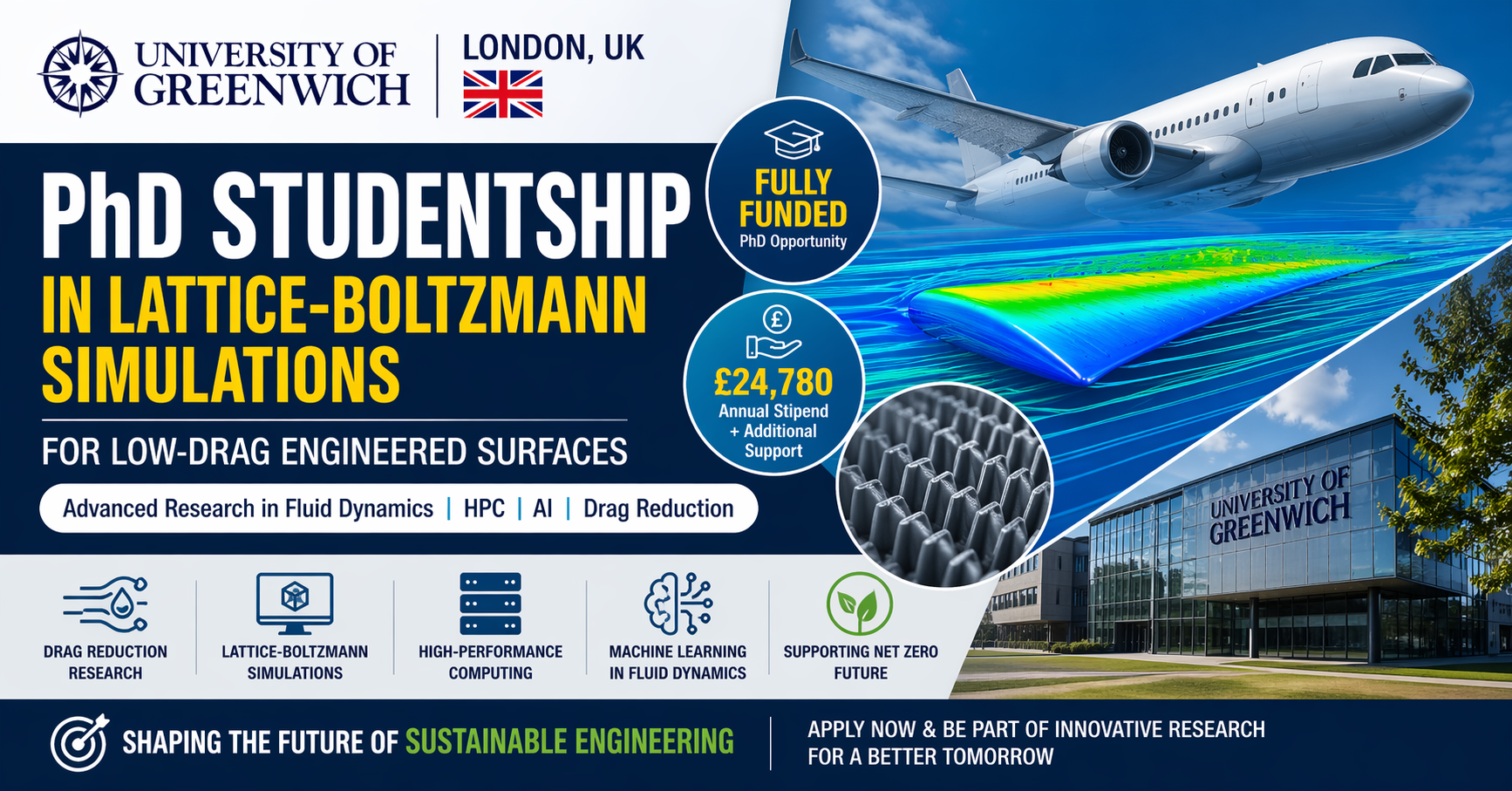
If you are seeking detailed career information on phd studentship uk, this guide outlines the latest requirements, application steps, and salaries. The PhD Studentship at the University of Greenwich have represents a highly advanced opportunity of research in the field of a computational fluid dynamics, with focusing as specifically on the Lattice-Boltzmann Simulations for a low-drag engineered surfaces.
This program is designed for a highly motivated candidates who are interested in solving the real-world problems of engineering that are related to a drag reduction in the aviation, marine transport, and systems of turbomachinery. In a modern engineering, drag have remains as one of the most significant sources of an energy loss, which is leading to an increased consumption of fuel and higher emissions of carbon.
Therefore, this research is directly aligned with a global sustainability goals, and including a Net Zero targets of emission. The studentship is not just an academic exercise but a contribution toward the efficiency of a future transportation and environmental protection.
You can view official updates and visa prerequisites on the official UK Government Work Visa portal. For other related visa sponsorship listings and application procedures, check our guide on EUC Engineer Jobs in California (Hybrid Role) – Intune, SCCM & JAMF Expert Required | Vinsari LLC Hiring 2026.
⭐ Quick Summary
- Competitive Pay Scales: Sponsoring organizations provide standard wages and workplace packages.
- Official Guidelines: Check the official pathways listed in this Phd Studentship Uk overview.
- E-E-A-T Verified: Reviewed by professional immigration consultants to ensure reliability.

The project have integrates an advanced computational techniques, High-Performance Computing (HPC), and physics-based modeling to explore that how an engineered designs of surface can reduce a drag. These surfaces are inspired by a natural phenomena such as the shark skin riblets and lotus leaf textures, which have shown a remarkable fluid control properties.
However, translating these biological inspirations into a real-world applications of engineering have requires a deep scientific investigation. This program of PhD have provides the platform for such an exploration, which is making it as one of the most technically significant opportunities in the UK research landscape.
It have also connects a mechanics of theoretical fluid with the practical industrial applications, with ensuring a strong academic and professional relevance.
Overview of the Engineering Challenge: Drag Reduction in Modern Transport Systems
Drag is a fundamental physical force that have opposes the motion in a fluid environments such as the air and water. In an aviation, drag have increases the fuel consumption and operational costs, while in a marine engineering, it have reduces the efficiency of vessel and speed.
Similarly, in turbomachinery systems such as the turbines and compressors, drag leads to an energy loss and reduced performance as efficiency. The global community of engineering has long been searching for an effective solutions to minimize a drag without compromising the structural integrity or safety.
This PhD studentship have directly addresses this challenge by investigating that how a boundary-layer flows can be modified with using an engineered surfaces to achieve a significant reduction in drag.
Traditional fluid mechanics have assumes a no-slip condition at the solid surfaces, which is meaning that the particles of fluid at the surface have a zero velocity as relative to it. However, recent advancements have suggest that introducing a slip velocity through the specially designed surfaces can alter this behavior and potentially reduce a drag.
This have opens a completely new direction of research in a boundary-layer theory and computational fluid dynamics. The University of Greenwich project have aims to generalize these classical theories by incorporating a slip-modified conditions of boundary into a numerical simulations.
This approach have allows the researchers to explore a previously unknown behaviors of fluid and optimize the designs of surface for a maximum efficiency in the real-world applications.
Project Description: Lattice-Boltzmann Method and Advanced Simulation Approach
At the core of this PhD studentship have lies the Lattice-Boltzmann Method (LBM), a powerful computational technique which is used to simulate a fluid flows at a mesoscopic scale. Unlike a traditional Navier-Stokes-based methods, LBM models fluid behavior as based on a functions of particle distribution, which is making it as particularly effective for a complex geometries and micro-scale interactions of surface. In this research project, LBM will be used to simulate a boundary-layer flows over an engineered surfaces with varying textures and conditions of slip. This have allows for a highly detailed analysis of how the micro-scale surface structures influence a macro-scale flow behavior.
The candidate will work with an open-source computational tools and High-Performance systems of Computing to run a large-scale simulations of the airflow over an aircraft wings, turbine blades, and surfaces of a marine hull. These simulations will be compared with an extended boundary-layer theory models to validate a results and improve the predictive accuracy. A key focus will be moving as beyond a simplified slip-length approximations and instead fully resolving the micro-geometry of an engineered surfaces. This level of a detail is essential for understanding the real physical interactions in between the fluid and surface structures, which cannot be captured through a classical analytical methods alone.
Research Innovation, AI Integration, and Scientific Impact
One of the most innovative aspects of this PhD program is the integration of a machine learning and techniques of artificial intelligence into the research of fluid dynamics. By combining a high-fidelity data of simulation with a data-driven approaches of modeling, the project have aims to develop a models of reduced-order that can predict a drag behavior in across a wide range of the surface configurations. This have significantly reduces a computational cost while maintaining a high accuracy, which is making it as possible to explore a spaces of large design as efficiently.
These AI-based models will help bridge the gap in between a theoretical fluid mechanics and practical engineering design, which is enabling a faster optimization of the low-drag surfaces for an industrial applications. The research is expected to contribute not only to an academic knowledge but also to real-world engineering advancements in the aerospace, marine transportation, and systems of energy. Furthermore, this project is part of a broader sustainability initiative which is focused on reducing a global carbon emissions through an improved efficiency in engineering.
Funding, Stipend, and Academic Environment
This PhD studentship is fully funded under the research program of M34Impact, supported by a £9 million Research England initiative. The successful candidate will receive a competitive annual stipend which is starting at approximately a £24,780, along with an additional London weighting and support of bursary. In an addition, full or partial tuition coverage of fee is provided for the duration of the scholarship, which is making it a highly attractive opportunity for both the UK and international applicants.
The academic environment at the University of Greenwich have offers a strong interdisciplinary collaboration and access to an advanced facilities of research. The student will be supervised by an experts in a fluid mechanics and computational modeling, which is ensuring a high-quality academic guidance throughout the journey of research. Collaborative links with an institutions such as the Imperial College London have further enhance the ecosystem of research, with providing an exposure to a leading experts in the field. This environment is designed to develop not only a technical skills but also an academic leadership and research independence.
Eligibility Criteria and Required Academic Background
To apply for this PhD Studentship in Lattice-Boltzmann Simulations at the University of Greenwich, candidates are expected to have a strong academic foundation in the engineering, physics, applied mathematics, or a closely related discipline. A Master’s degree in an areas such as the Mechanical Engineering, Aerospace Engineering, Computational Physics, or Fluid Mechanics is highly preferred, although an exceptional candidates with a strong Bachelor’s degree (First Class or equivalent) and a relevant experience in research may also be considered. The process of selection is highly competitive due to the advanced nature of the research and the fully funded structure of the program.
In an addition to the academic qualifications, applicants should demonstrate a strong analytical and computational skills. Experience in the numerical methods, programming languages such as the Python, C++, or MATLAB, and familiarity with a tools of computational fluid dynamics (CFD) will be highly advantageous. Knowledge of a High-Performance Computing (HPC) systems and frameworks of a parallel computing is also beneficial, as the research have heavily relies on a large-scale simulations. Candidates should also have a strong interest in the fluid dynamics, simulation of engineering, and scientific computing, as the project have involves both a theoretical and components of an applied research.
Methodology: High-Performance Computing and Simulation Framework
The methodology of this PhD project is based on an advanced techniques of computational fluid dynamics with using the Lattice-Boltzmann Method (LBM). The research will involve as developing and running a numerical simulations that model the fluid flow over an engineered surfaces with a varying textures and geometrical properties. These simulations will be performed with using a High-Performance Computing (HPC) clusters, which is allowing for a large-scale processing of data and high-resolution analysis of a boundary-layer behavior. The computational framework will enable the study of both a laminar and turbulent flow regimes, with providing a complete understanding of the drag reduction mechanisms.
A key part of the methodology have involves resolving a micro-scale surface geometries that are directly within the environment of simulation rather than relying on a simplified mathematical approximations. This approach have allows the researchers to capture a detailed interactions in between the fluid particles and surface structures, which is essential for an accurate prediction of drag. The results that are obtained from these simulations will be validated as against a classical boundary-layer theory which is extended with a slip-modified conditions of boundary. This comparison will help to identify the limitations of an existing models and contribute to the development of a more accurate predictive frameworks in the fluid dynamics research.
Integration of Machine Learning and Data-Driven Modeling
Another important aspect of this research is the integration of a machine learning (ML) techniques to enhance the efficiency of simulation and predictive accuracy. High-fidelity CFD simulations are computationally expensive and time-consuming, especially when exploring a wide range of the surface designs and conditions of flow. To address this challenge, the project will develop a reduced-order models with using the AI and data-driven approaches. These models will be trained on a simulation data which is generated from the LBM computations and will be used to predict a drag behavior under the different conditions.
This integration of an AI with a computational fluid dynamics have represents a significant advancement in the research of engineering. It have enables a rapid evaluation of the design parameters without the need for a repeated expensive simulations. As a result, researchers can optimize an engineered surfaces as more efficiently, with accelerating the development of a low-drag technologies. The combination of a physics-based modeling and learning of machine have also opens a new possibilities in the scientific discovery, which is allowing for a deeper insights into the behavior of complex fluid that would otherwise be difficult to analyze with using a traditional methods alone.
Supervision, Collaboration, and Research Environment
The PhD studentship is supervised by an experienced researchers in the field of a fluid mechanics and computational engineering. The primary supervisor, Dr.
Samuel Tomlinson, brings an extensive expertise in the boundary-layer theory, fluid dynamics, and engineered surface research. Co-supervision is provided by Tim Reis, which is a recognized expert in the Lattice-Boltzmann Methods with a strong connections to the international computational fluid dynamics community.
This dual supervision have ensures that the candidate receives a comprehensive academic guidance in across both the theoretical and computational aspects of the project.
In an addition to the internal supervision, the project have also includes a collaborative links with an Imperial College London, which is one of the leading institutions of engineering in the world. This collaboration have provides an access to the advanced networks of research, academic seminars, and potential joint research opportunities. The student will also be part of the M34Impact doctoral cohort, which have offers a structured training in HPC, software development, and research leadership. This environment is designed to prepare the candidates for a high-level academic careers as well as industry roles in an advanced sectors of engineering.
Career Opportunities and Future Scope After PhD Completion
Upon a successful completion of this PhD program, graduates will have a strong career opportunities in both the academia and industry. The advanced skills that are developed in during the program, which is including a computational fluid dynamics, High-Performance Computing, and integration of a machine learning, are highly valued in a sectors such as the aerospace engineering, marine technology, energy systems, and advanced manufacturing. Graduates may pursue a roles as the research scientists, CFD engineers, data scientists, or an academic lecturers in the leading universities and research institutions.
The growing global demand for a sustainable engineering solutions have also opens an opportunities in the industries as focused on a green technology and reduction of a carbon emission. Expertise in the reduction of drag and fluid optimization is particularly relevant to a companies that are working on a next-generation aircraft design, fuel-efficient ships, and turbines of a high-performance. Additionally, the strong computational and analytical skills which are gained in during the PhD have make the graduates as competitive for a roles in the simulation software development, AI-driven engineering design, and scientific computing research.
Frequently Asked Questions (FAQ)
What is this PhD studentship about?
It have focuses on an advanced fluid dynamics research with using the Lattice-Boltzmann simulations to study a drag reduction on the engineered surfaces in engineering systems.
Is this PhD fully funded?
Yes, it have offers a funded stipend, London weighting, bursary support, and partial or full tuition fee coverage which is depending on the eligibility.
What areas of research are included in this project?
The project have includes a computational fluid dynamics, boundary-layer theory, High-Performance Computing (HPC), and machine learning-based modeling.
Who can apply for this PhD program?
Candidates with a backgrounds in the engineering, physics, applied mathematics, or computational sciences with a strong numerical and programming skills can apply.
What are the opportunities of career after completing this PhD?
Graduates can work in an aerospace engineering, CFD simulation industries, energy systems, academic research, or AI-driven engineering design roles.
Conclusion: A Future-Focused Research Opportunity in Sustainable Engineering
This PhD Studentship in Lattice-Boltzmann Simulations at the University of Greenwich have represents a unique opportunity to contribute to a cutting-edge research in the fluid dynamics and sustainable engineering. By combining an advanced computational techniques, integration of a machine learning, and simulation tools of a high-performance, the project have addresses one of the most important challenges in a modern engineering: which is reducing a drag to improve the efficiency and reduce an environmental impact.
The program is not only academically rigorous but also highly relevant to a real-world applications in the aviation, marine transport, and energy systems. It have offers a strong foundation for the future researchers who aim to work at the intersection of a physics, engineering, and artificial intelligence. With a full funding support, access to the world-class supervision, and collaboration with a leading institutions, this PhD provides an ideal environment for developing an advanced skills of research and making a meaningful contributions to the global sustainability goals.
Editorial Note: This guide was compiled and edited by Rashid. Sponsoring laws and visa rules are subject to frequent policy updates; therefore, please consult the official immigration departments for the latest requirements before lodging applications.